
Adult Dog Manners
How to stop a dog jumping on people (and why pushing him down makes it worse)
Jumping up is a greeting that has been paid for with attention. This plan stops the pay, manages the door, and teaches a greeting that earns everything your dog wants with four paws on the floor.
On this page (11 sections)
- Why dogs jump on people
- Why pushing him down and saying "off" backfires
- How to stop a dog jumping on people: the greeting plan
- Management at the door while you train
- A script for your guests
- A practice session at the front door
- Troubleshooting: when the jumping won't stop
- When to get professional help
- Frequently asked questions
- Keep going
- Sources
If your dog launches at every guest who walks through the door, and pushing him down and saying "off" only makes it more frantic, you haven't ruined him and he isn't being stubborn: the pushing and the "off" are attention, and attention is what he is jumping for. Learning how to stop a dog jumping on people comes down to three things done together: manage the door so he can't practice jumping, teach a greeting he can't do while jumping (four paws on the floor, then a sit), and give every guest the same short script.
VCA's veterinary behaviorists explain that dogs jump to get closer to our faces, and that most of the time the jump is followed by attention, so it is repeated. Dogs Trust adds that some dogs jump because they are anxious, frustrated or in pain, so the plan starts by checking which dog you have. It follows the reward-based advice of Dogs Trust, VCA, the San Francisco SPCA and Best Friends Animal Society, with "move on when" tests instead of deadlines.
Key takeaways
- Pushing, scolding and "off" are still attention, so they can keep jumping going (VCA, Best Friends, Dogs Trust).
- Expect it to get worse before it gets better: Dogs Trust says dogs try harder when a behavior stops working.
- Teach four paws on the floor first, then a sit, by feeding low before your dog has a chance to jump (VCA).
- Manage every arrival while you train: a gate, a closed door or a leash, plus a mat at the entrance.
- Everyone has to follow the same rules. Rewarding jumping only sometimes makes it stronger (VCA).
- Never knee, step on toes, or pull your dog down by the collar or leash (SF SPCA, Dogs Trust).
If your jumper is a puppy
Start now: Dogs Trust says a puppy is never too young to learn, and a calm greeting is easier to teach while they are small. Best Friends notes it gets harder as puppies grow. Use the same steps in shorter sessions, alongside the puppy socialization checklist. Puppies often add mouthing, which how to stop puppy biting covers. And if a puppy class didn't fix greetings, that is not your failure: greetings happen at your own door, with your own guests, which is exactly where this plan practises.
Before your next guest arrives
- Decide where your dog will be when the door opens: behind a gate, in another room, or on a leash (Best Friends, Dogs Trust).
- Put a jar of small treats outside the front door so every visitor can reward a calm greeting (Best Friends).
- Send your guest the script in the guest section below.
Why dogs jump on people
Most dogs are shorter than us, and jumping brings them closer to our faces (VCA). When the jump earns a look, a word or a touch, the dog learns it works. Dogs Trust lists excitement, frustration, stress, anxiety and learned habit, and notes that some dogs jump if they are in pain, or to make themselves bigger while they say "go away".
That last group matters. Dogs Trust describes an anxious dog jumping at visitors with a tense body, ears back and tail tucked; an excited dog has a loose, wiggly body and a relaxed wagging tail. This plan is for the excited dog. If yours looks worried, read when to get professional help first.
Why pushing him down and saying "off" backfires
From your dog's point of view, a push is contact and "off!" is conversation. VCA's behaviorists say that whether you scold your dog or push him away as he jumps, you are still giving him attention, and that even negative attention can be rewarding. Dogs Trust adds that being told off distresses some dogs, and the anxiety can make them jump even more.
Three more reasons to stop:
- It can make your dog wary of people. VCA warns that if a dog is startled or hurt while seeking social contact, they may associate it with the person they were greeting, which can make dogs fearful of family members, visitors or strangers.
- It can injure your dog. The SF SPCA says never to bring your knee up, step on their toes, or grab and pinch their feet: you can cause real damage, and your dog won't understand what you want.
- Leash and collar tension hurts. Dogs Trust says not to use the collar, harness or leash to pull your dog down, because the pain may become linked to you or the equipment.
And the "more frantic" part? Dogs Trust explains that when you stop responding the way your dog expects, they are likely to try the same behavior with greater intensity for a while. That burst is part of learning, and it fades if jumping never pays again.
How to stop a dog jumping on people: the greeting plan
Use short sessions and small treats. Change one thing at a time (excitement, place or person), as VCA advises, and go back a step whenever jumping returns.
Pick the greeting you want
Choose one behavior your dog can't do while jumping. Dogs Trust suggests a sit, carrying a toy or touching their nose to your hand; if a cue is too hard in the moment, four paws on the floor is enough. VCA suggests mastering four-on-the-floor first and adding the sit afterwards.
Four-on-the-floor with family, indoors
In a quiet room, as your dog walks toward you, drop a treat between their front paws before they try to jump (VCA). Then roll a treat a few feet away so they come back to greet you again. Feeding low keeps the paws down, and a calm "Hello" can become the cue.
Move on when: your dog approaches and pauses with four paws down, looking at you or the floor for the treat.
Add the sit
If your dog doesn't know sit yet, Best Friends describes the lure: hold a treat at the nose and raise it toward the top of the head; as the head goes up, the rear goes down. Mark with "yes" and reward. Then ask for a sit as your dog reaches you, after the calm approach (VCA).
Move on when: your dog sits as they arrive, often before you ask.
Practise the front door, with you as the visitor
Put a mat or dog bed inside the entrance and a treat jar outside the door (Best Friends). Step out, take a treat, and come back in asking for a sit on the mat; reward only when your dog sits. For coming home, the SF SPCA suggests opening the door a crack and closing it if your dog jumps, until you can step through with four paws on the floor. Then add a knock or the doorbell (Best Friends).
Move on when: your dog sits on the mat as you walk in, even after the bell.
A calm helper, on leash
With your dog on a leash, ask a friend your dog is relaxed around to walk toward you. Just before your dog would jump, ask for the sit and reward (Dogs Trust). VCA suggests holding the leash just taut enough that your dog can't easily jump, without pulling or jerking. If your dog won't sit or take treats, the helper starts further away. Once your dog stays seated, the helper can chat with you, then stroke the shoulder or chest, not over the head (Dogs Trust).
Move on when: your dog stays seated while the helper says hello and strokes them.
New people, then the outside world
Practise with different people (Dogs Trust; VCA suggests familiar people before new visitors). Then take it on walks: Best Friends suggests asking people not to approach unless your dog is sitting, and Dogs Trust says your dog never has to greet everyone.
Keep going: Best Friends says to reward with food every time while your dog is learning, then use praise sometimes, but keep using food often enough to maintain the greeting.
Management at the door while you train
AVSAB's position statement on humane training says common problems such as jumping can be managed by arranging the environment and reinforcing the behavior you want. Management means your dog can't practice jumping on guests while the training catches up.
| Set-up | When to use it | How it works |
|---|---|---|
| Separate room, gate or exercise pen | Early training, busy arrivals, children visiting | Your dog can't reach the door. Reward calm sitting behind the barrier, then remove it once sitting is reliable (Best Friends) |
| Leash on before the door opens | Once your dog can sit on cue at home | Hold it just taut enough to prevent a jump, never jerking (VCA). The SF SPCA suggests leaving it on, dragging, during the visit |
| Mat or bed by the entrance | Every arrival during training | A clear place to sit, comfier than tile or wood (Best Friends) |
| Scattered treats | The first few seconds of a greeting | Sprinkling treats on the ground keeps your dog's nose down (Dogs Trust) |
If your dog also drags you toward people on walks, the same "calm earns the hello" idea runs through loose-leash walking.
A script for your guests
Consistency is the whole game. VCA warns that if a calm greeting is rewarded only sometimes, or jumping still pays with some people, jumping can increase. Send this to visitors before they arrive:
- At the door: "Please don't greet the dog yet. If he jumps, cross your arms and turn sideways, and don't look at, speak to or touch him." (Dogs Trust, VCA)
- When his paws are down: "Take a treat from the jar and drop it on the floor, or give it when he sits." (Best Friends, Dogs Trust)
- Saying hello: "Once he is sitting calmly, stroke his chest or shoulder. A hand over his head makes jumping hard to resist." (Dogs Trust)
For visits with children, Dogs Trust suggests keeping your dog separate or on a leash if they are likely to jump up, even indoors, because dogs can knock children over by accident.
A practice session at the front door
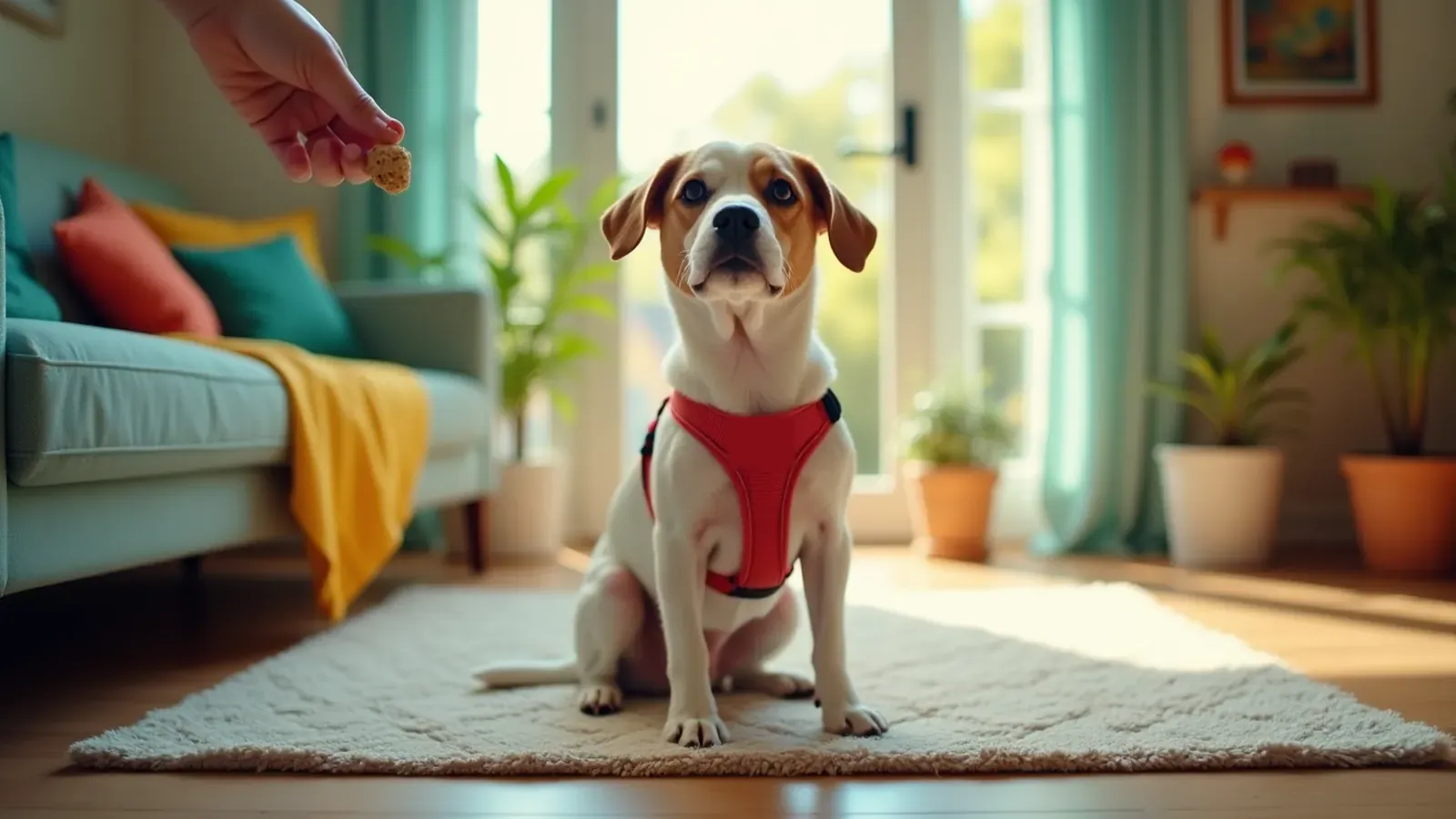
A friend the dog knows takes a treat from the jar on the step and knocks. Inside, the dog is on a leash beside the mat. The door opens; the dog surges, the leash stops the jump, and the friend crosses her arms and turns sideways. A second later, four paws land: she drops a treat on the floor. The owner asks for a sit and rewards it. After a few more entries the dog sits on the mat before anyone asks, and the friend strokes his chest. They stop on that success.
Troubleshooting: when the jumping won't stop
- If the jumping got worse when you started ignoring it
- That is the burst Dogs Trust describes: persevere, stay calm and consistent, and reward the first moment of four paws down. If it is too intense to wait out, leave the room (Dogs Trust).
- If one person still lets the dog jump
- Hold a family meeting, as VCA suggests: nobody pets or treats the dog for jumping. If someone loves a "hug", VCA suggests teaching it as a separate trick on cue, after a calm greeting first.
- If your dog is too excited to sit or take treats
- The person is too close or the moment is too exciting. Have your helper start further away (Dogs Trust), and give your dog time to wind down after exciting events; Dogs Trust suggests sniffing or licking activities.
- If your dog grabs your sleeve while jumping
- Stay still and don't pull your arm away, which can turn it into a game (Dogs Trust). Keep a chew or toy handy to offer instead.
- If your dog jumps on you every time you come home
- Have treats or a toy ready as you open the door, and engage before the jump starts (Dogs Trust).
When to get professional help
Stop and call for help if
- Your dog jumps at visitors or strangers with a tense body, ears back or tail tucked, or seems to want them to go away. Dogs Trust says a qualified expert can help change how your dog feels before you teach an alternative.
- Jumping comes with biting, not just mouthing. Dogs Trust says biting can cause significant and lasting damage, and a dog who feels threatened may use aggressive behavior to communicate.
- Jumping is new, or your dog may be in pain. Dogs Trust lists pain as one reason dogs jump; see your vet first.
- Your dog leans away, looks away or lowers their body when people reach for them. VCA says never let anyone touch a dog showing signs of avoidance or fear.
Who to call. Start with your veterinarian: pain, illness and medication side effects can all show up as behavior changes. For behavior problems, look for a board-certified veterinary behaviorist (ACVB directory), a certified applied animal behaviorist, or a certified behavior consultant, for example through the IAABC or the CCPDT directories. Ask any trainer which methods they use; reward-based is what the American Veterinary Society of Animal Behavior recommends.
Recently adopted? Start with settling a rescue dog, and add a reliable recall later so you can call your dog away from guests.
Frequently asked questions
How do I keep my dog from jumping on strangers?
Keep your dog on a leash around strangers if they are likely to jump up, and use treats or a toy to keep their attention on you (Dogs Trust). Best Friends suggests asking people not to approach unless your dog is sitting. Your dog doesn't have to greet everyone, and should always be able to move away.
What are the most common mistakes when a dog jumps up?
Giving attention for jumping (even pushing or "get down"), letting some people allow it, and punishing it. VCA says inconsistent rewards make jumping stronger, and Dogs Trust says pushing your dog down, shouting or punishing can make the behavior worse and create other problems.
Is a dog who jumps on people being dominant?
No. The SF SPCA says jumping is the canine way of saying hello, not an attempt to dominate you or done out of spite. Your dog simply hasn't learned another way to greet people yet, which is exactly what the plan above teaches.
Sources
- How to stop your dog jumping up at people, Dogs Trust (accessed October 27, 2026).
- Dog Behavior Problems: Greeting Behavior, Jumping Up, Ellen Lindell, VMD, DACVB, Monique Feyrecilde, LVT, VTS (Behavior), Debra Horwitz, DVM, DACVB and Gary Landsberg, DVM, DACVB, VCA Animal Hospitals (accessed October 27, 2026).
- Train your dog not to jump up on people, VCA Animal Hospitals (accessed October 27, 2026).
- Jumping, San Francisco SPCA (accessed October 27, 2026).
- How to Stop Dogs From Jumping on People, Best Friends Animal Society (accessed October 27, 2026).
- Position Statement on Humane Dog Training, American Veterinary Society of Animal Behavior (accessed October 27, 2026).
More everyday manners, step by step
Jumping up, leash pulling and coming when called, in the order that makes each one easier, all taught with rewards.