
New Puppy
How to crate train a puppy, step by step (even one who backs away)
A crate should feel like a den your puppy picks, not a box you push them into. These seven steps build that feeling at your puppy's pace, with a schedule for how long they can stay in.
On this page (8 sections)
If your puppy backs away from the crate and ignores the treats you toss inside, the crate has started to feel like a trap, and you can change that. Learning how to crate train a puppy is mostly about going slower than feels necessary: the door stays open, the puppy chooses to go in, good things happen there, and only then does the door close, for a few seconds at first, as the SF SPCA describes.
Wrestling a puppy in before every nap, then lying awake while they cry, is exhausting, and it doesn't mean you have ruined anything. Dogs Trust and the RSPCA both describe going back a step or two when a puppy is worried, so you restart from wherever your puppy is comfortable. The plan below follows the step-by-step advice of Humane World for Animals, the RSPCA, Dogs Trust, the San Francisco SPCA and VCA Animal Hospitals. Every puppy is different, so the steps have "move on when" tests instead of fixed days.
Key takeaways
- Never force, push or shut a reluctant puppy in. Humane World says simply: don't force them to enter.
- Fix the door open at first so it can't swing shut and scare your puppy.
- Reward the choice, not the bribe: drop treats in after your puppy goes in, and wait instead of luring them back.
- Feed meals in the crate, moving the bowl further back each time.
- Close the door for seconds, then minutes, and go back a step at the first whine or scrabble.
- Young puppies can't hold on for long. The SF SPCA suggests up to one hour at 8 to 10 weeks.
- Never use the crate as a punishment.
Do this today
- Set the crate up where the family spends time, with soft bedding, and fix the door open.
- Drop a few treats beside it while your puppy is busy elsewhere, and walk away.
- Serve dinner next to the crate (or just inside the doorway if your puppy is relaxed about it).
If a class didn't fix it
A class can show you the idea, but crate training happens at home, in many short sessions (the RSPCA suggests about three minutes each). What follows is that home routine, broken into small steps with a clear test for when to move on, so you are never guessing what to do next.
Before you start: crate size, place and comfort
Sources agree the crate should let your puppy stand up, turn around and lie down comfortably. Dogs Trust adds sit, wag and stretch out fully. They differ on whether to buy the adult size now. The SF SPCA says no larger than that, because a puppy may use one end as a toilet and the other as a bed. Humane World suggests choosing a size that will fit the adult dog, and VCA's behaviorists suggest a divider if the puppy starts sleeping at one end and toileting at the other. A divider in an adult-size crate meets both points.
Put the crate where the family spends time, such as the living room. Add soft bedding and a chew toy. Dogs Trust and the RSPCA both say your puppy should have access to water; a clip-on or non-spill bowl helps. The RSPCA adds that a cover over part of the crate can help nervous dogs.
How to crate train a puppy in 7 steps
Humane World says crate training can take days or weeks, depending on age, temperament and past experiences, and VCA says a puppy will likely get used to the crate within one to two months. The RSPCA suggests keeping sessions short, about three minutes. Two rules run through every step: the crate is always linked with something pleasant, and you move in small steps.
Let the crate just be furniture
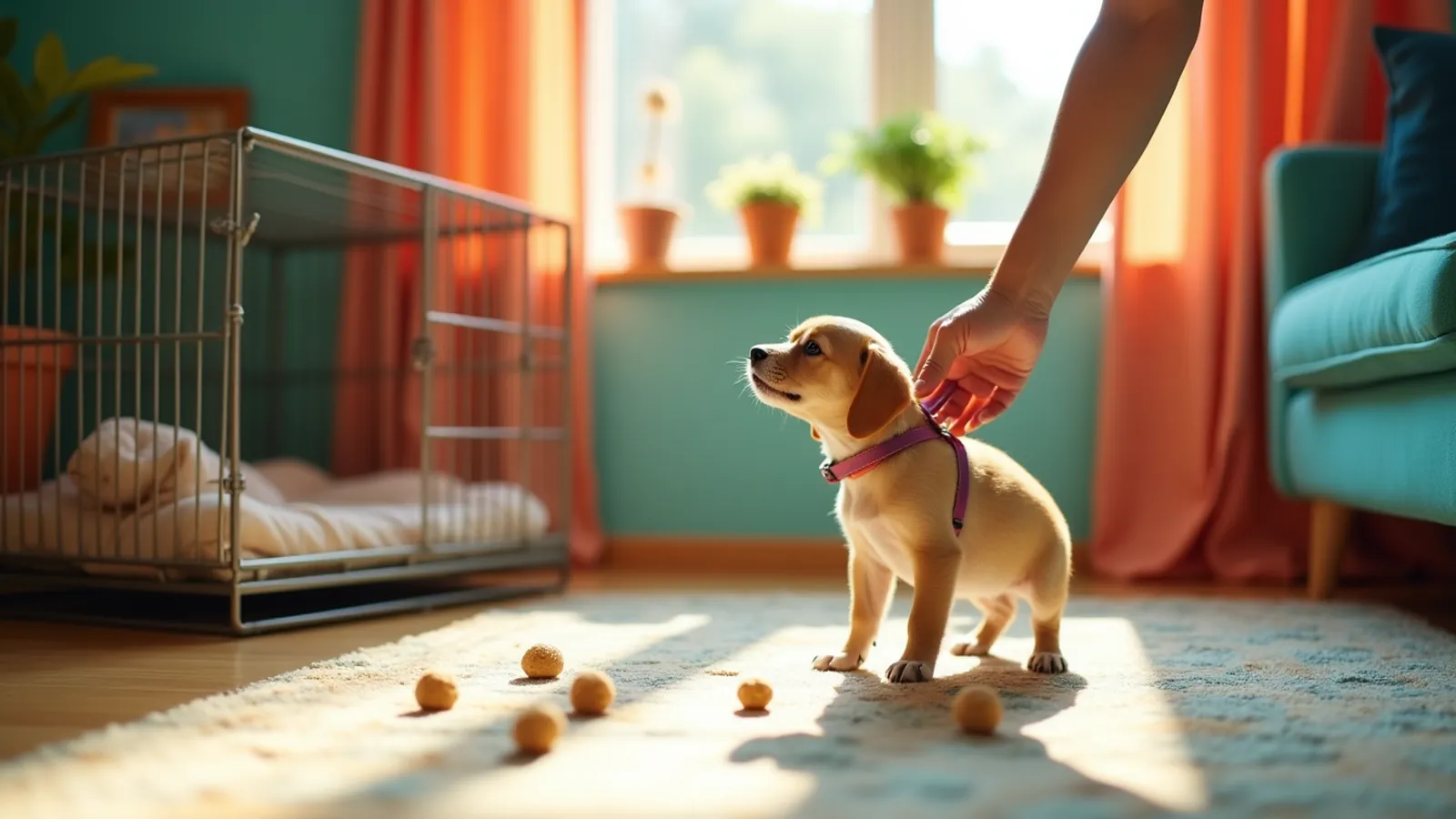
With the door fixed open, let your puppy sniff and explore in their own time. Dogs Trust suggests leaving a few treats around the crate for your puppy to find, so it becomes a place where good things turn up.
Move on when: your puppy walks past or near the crate without hesitating.
Treats near, then at, then inside the door
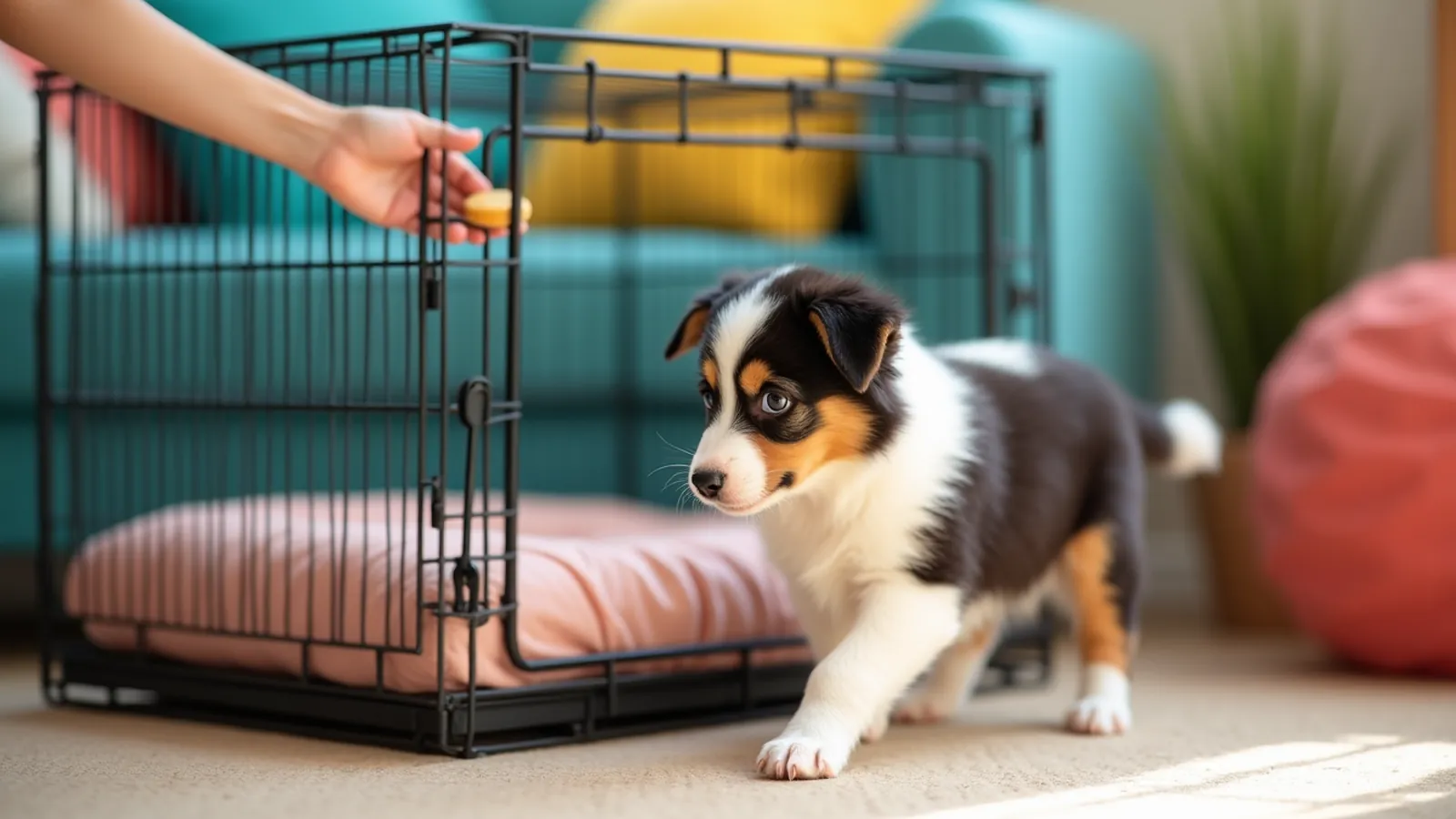
Humane World suggests dropping small treats near the crate, then just inside the door, then all the way in. If your puppy won't go all the way in, that's okay: don't push. If treats don't interest your puppy, try a favorite toy instead. This stage can take a few minutes or several days.
Move on when: your puppy walks calmly all the way in to get a treat.
Reward choices, don't lure
Now stop tossing treats ahead of your puppy. Dogs Trust suggests standing beside the crate and dropping treats onto the bed when your puppy goes in, ideally when your puppy isn't looking at you, so the focus is the crate. If your puppy walks out, stop and wait. Don't call or lure them back; drop treats again when they return. This is the difference between a bribe (shown first, to get compliance) and a reward (given after a free choice).
Move on when: your puppy goes in by themselves to see if anything has appeared.
Meals in the crate
Feed meals near the crate, then inside it, moving the bowl a little further back each meal, as Humane World and the RSPCA describe. If your puppy is reluctant, start with the bowl outside the crate and move it in over several meals.
Move on when: your puppy stands comfortably in the crate to eat.
Close the door, briefly
Close the door while your puppy eats and open it as soon as the meal is finished. With each meal, leave it closed a few minutes longer, until your puppy stays about 10 minutes after eating (Humane World, RSPCA). Dogs Trust suggests half-closing the door first, without latching it, so your puppy can still leave.
Move on when: your puppy rests for about 10 minutes after a meal with no whining.
Step away, then out of sight
Give a food-stuffed toy, close the door and sit nearby for five to 10 minutes. Then go into another room for a short time, come back, sit quietly and let your puppy out (Humane World). Repeat several times a day, building the time you are out of sight. The RSPCA says to wait for even the smallest gap in any noise before you open the door.
Move on when: your puppy stays quietly in the crate for about 30 minutes with you mostly out of sight.
Short absences and nights
Start leaving the house for short periods. Humane World suggests keeping departures and arrivals matter-of-fact and still crating your puppy sometimes while you are home, so the crate doesn't always predict being alone. At night, keep the crate in or near your bedroom at first so you can hear when your puppy needs a toilet trip.
Keep going: leave the door open when you are home so your puppy can use the crate as a resting place.
A puppy who loves the crate also gives you a calm place for naps, which helps with puppy biting fuelled by tiredness. The New Puppy start-here page puts the crate, sleep and toilet training in order.
Crate training schedule: how long a puppy can stay in
Quick rule: start with minutes, stay under the SF SPCA figure for your puppy's age, and never go past three to four hours at a time. Nights are the exception, but young puppies still need the overnight toilet trips VCA describes below. The figures below are maximums for a puppy who is already comfortable in the crate, not targets. The sources give different numbers, so the table shows both and the shorter one to use while your puppy is learning.
| Puppy's age | SF SPCA time guide | Humane World rule of thumb (age in months plus one hour), calculated | Use this while learning (the shorter figure) |
|---|---|---|---|
| 8 to 10 weeks | Up to 1 hour | About 3 hours at 2 months | Up to 1 hour |
| 11 to 12 weeks | Up to 2 hours | About 4 hours at 3 months | Up to 2 hours |
| 13 to 16 weeks | Up to 3 hours | About 4 to 5 hours at 3 to 4 months | Up to 3 hours |
| Over 4 months | Up to 4 hours | Humane World also says puppies under 6 months shouldn't stay in more than 3 or 4 hours at a time | Up to 3 to 4 hours |
Both organizations set a ceiling: the SF SPCA says never to leave a dog of any age in the crate longer than three to four hours at a time except at bedtime, and the RSPCA says it is never acceptable to shut a dog in a crate all day while you go to work. Nights are different. VCA suggests taking a 2-month-old puppy out at least every two hours, even overnight, and a 3-month-old every three hours. The puppy potty training schedule has the full day of toilet trips.
7:00 toilet trip, breakfast in the crate with the door open, play. 8:30 toilet trip, then a nap in the crate with a chew, door closed, you nearby. 9:30 out, toilet, play and a short training game. Midday: lunch in the crate, toilet, nap. Afternoon: two or three more short crate naps, each one followed straight away by a toilet trip. Evening: calm play, last toilet trip, then the crate beside your bed. Each closed-door stretch stays under the SF SPCA's one-hour guide for this age.
Troubleshooting: when the crate isn't working
- If your puppy backs away from the crate entirely
- Go back to step 1. Take the door off or fix it open, put treats only near the crate, and feed meals beside it. Dogs Trust says to move at your puppy's pace and keep sessions short and fun, at calm times of day.
- If your puppy goes in but bolts when the door moves
- Practise the door movement more gradually: half-close it without latching, as Dogs Trust describes, and make sure it can't swing and bang.
- If your puppy whines as soon as the door closes
- You may have moved too fast. The RSPCA says to go back a few steps if you see whining, panting, excessive barking or cowering. Wait for a moment of quiet before opening, so noise isn't what opens the door.
- If your puppy soils the crate
- Check the space and the time. A crate that is too big, or a stretch longer than your puppy can hold on, makes accidents likely. Shorten the time and use a divider.
- If your puppy only ever goes in for food
- That is normal at first. Dogs Trust says you will need fewer treats over time as your puppy starts to choose the crate to relax.
Watch for
Never use the crate as a punishment or for time-outs (Humane World, RSPCA, VCA). Teach children not to poke fingers through the bars, tap the sides or disturb a puppy resting inside; Humane World calls it your dog's safe zone. If you need a bigger space, Dogs Trust notes that a playpen can suit nights better because it gives more room to move.
When to get professional help
Stop and call for help if
- Your puppy drools, cries persistently, tries to escape or can't settle in the crate. VCA's behaviorists say to consult your veterinarian before continuing.
- Your puppy is very distressed. VCA says to let them out, end the session, and pause training until you have professional guidance.
- Your puppy hurts itself trying to get out, or panics whenever left alone. Humane World says a crate won't solve separation anxiety and a dog may get injured trying to escape.
Who to call. Start with your veterinarian: pain, illness and medication side effects can all show up as behavior changes. For behavior problems, look for a board-certified veterinary behaviorist (ACVB directory), a certified applied animal behaviorist, or a certified behavior consultant, for example through the IAABC or the CCPDT directories. Ask any trainer which methods they use; reward-based is what the American Veterinary Society of Animal Behavior recommends.
Distress that is about being alone, rather than about the crate, needs its own plan. Our guide to separation anxiety training explains the difference.
Frequently asked questions
When should I start crate training a puppy?
VCA's behaviorists say crate training can start at any age and that starting early makes it easier. VCA also suggests introducing the crate as soon as the puppy comes home, as early in the day as possible, so the first experience isn't at bedtime. AVSAB notes that puppies used to crates are less stressed if they later need to travel or stay in a hospital.
How long does crate training take?
There is no fixed timeline. Humane World says it can take days or weeks depending on age, temperament and past experiences, and VCA says a puppy will likely get used to the crate within one to two months. Progress through the steps by your puppy's comfort, not the calendar.
Should I let my puppy out when they cry in the crate?
If the crying could mean a toilet trip, take your puppy out calmly and bring them straight back. Otherwise, the RSPCA suggests waiting for even a short gap in the noise before opening the door. If crying keeps happening, go back a step. For nights, see puppy crying in the crate at night.
Can I leave my 8-week-old puppy in a crate while I'm out?
Only briefly, once they are relaxed in it. The SF SPCA suggests up to one hour at 8 to 10 weeks. Humane World suggests waiting until your puppy can stay quietly in the crate for about 30 minutes with you mostly out of sight before leaving them crated while you go out.
Sources
- How to Crate Train Your Dog or Puppy, Humane World for Animals (accessed October 27, 2026).
- Crate Training Puppy, San Francisco SPCA (accessed October 27, 2026).
- Playpen and Crate Training a Puppy, RSPCA (accessed October 27, 2026).
- Playpen and Crate Training a Puppy, Dogs Trust (accessed October 27, 2026).
- Crate Training and Confinement for Puppies and Dogs, Ellen Lindell, VMD, DACVB and Monique Feyrecilde, LVT, VTS (Behavior), VCA Animal Hospitals (accessed October 27, 2026).
- How to Crate Train Your Puppy, VCA Animal Hospitals (accessed October 27, 2026).
- How to Crate Train Your Dog, Debra Horwitz, DVM, DACVB and Gary Landsberg, DVM, DACVB, VCA Animal Hospitals (accessed October 27, 2026).
- Position Statement on Puppy Socialization, American Veterinary Society of Animal Behavior (accessed October 27, 2026).
New puppy? Start here
The first weeks with a puppy in the order that matters: sleep, toilet trips, the crate, biting and socialization.