
Rescue Dog
Dog separation anxiety training: a 6-step plan to build alone time
The fix is not longer absences but much shorter ones, built up so slowly that your dog never panics, plus a clear line for when your vet and a behavior professional need to be involved.
On this page (9 sections)
If your dog barks, paces and scratches at the door the second you leave for work, and the neighbors have started to complain, dog separation anxiety training is how you turn it around: you teach your dog that being alone is safe, one tiny absence at a time. You leave for less time than it takes your dog to get upset, and build up so slowly that panic never starts.
It is not spite, and you haven't failed your dog. The RSPCA says dogs are not trying to get "revenge"; in most cases they are simply distressed. It also notes that separation-related behavior is a common reason dogs are handed over to rescues, so if you are quietly wondering whether you can cope, you are far from alone. Mild cases can often be trained at home with the plan below, after a vet check. Moderate to severe separation anxiety, with signs such as panic, self-injury, destruction at doors and windows or house soiling only when alone, needs a qualified behavior professional as well: the ASPCA says treatment then requires the guidance of a trained and experienced professional.
Puppy or rescue, the same principle applies. VCA says puppies need to learn how to have alone time, and the RSPCA says introducing alone time gradually makes problems less likely later. For night-time crying, see puppy crying in the crate at night.
Key takeaways
- Film your dog alone first. The RSPCA and VCA both suggest a video to see what really happens.
- Plan every absence to be shorter than the time it takes your dog to become upset (ASPCA).
- Start with seconds. Go back a step at the first sign of stress.
- During training, avoid leaving your dog alone for longer than they can cope with. Arrange cover instead.
- Never punish. The RSPCA says separation problems get worse when owners punish their dogs on return.
- Panic, self-injury or destruction at exits: see your vet first, then get a qualified behavior professional's help.
Why this isn't another class
The problem happens when you are not there, so the training has to happen at home, at the door you actually leave through. The plan below is the home approach the ASPCA, the RSPCA and VCA describe, with a clear point at which to bring in a professional.
Do this today
- Set up a phone or camera and record the first 40 minutes after you leave.
- Book a vet check, so medical causes can be ruled out (ASPCA).
- Line up cover for your work hours: a friend, family member, dog sitter or daycare.
Is your rescue dog's barking separation anxiety or something else?
The ASPCA describes separation anxiety as distress when a dog is separated from the people it is attached to, often starting within minutes of the person leaving. VCA's veterinary behaviorists add that many of these dogs follow their owners from room to room and become anxious as soon as the owner prepares to leave. The key test is whether the behavior happens only when your dog is alone. If it also happens when you are home, something else is more likely.
| What you see | Points to separation anxiety if | Could also be |
|---|---|---|
| Barking or howling | It is persistent and seems triggered by nothing except being left alone | Barking at outside sounds, people or animals; it then happens when you are home too |
| Chewing, digging, scratching | It is aimed at doors, windows and exit points, and doesn't happen in your presence | Boredom (the dog doesn't seem anxious) or young-dog chewing that also happens when you are home |
| Urine or poo indoors | It happens only when your dog is alone | Incomplete house training, a medical problem such as incontinence, or urine marking |
| Pacing, drooling, trembling | It starts as you get ready to leave or soon after you go | Fear of something that happened while alone, such as storms or fireworks |
| Frantic escape attempts | It happens when alone and can cause injuries such as broken teeth or damaged nails | Distress about confinement itself, such as a crate or a shut room |
Signs can mix. A survey of 2,757 dogs by de Assis and colleagues found that separation-related problems are a group of signs with different underlying emotions, including frustration and panic, which is one reason a professional assessment matters when signs are strong.
Sources disagree on rescue dogs: the ASPCA says far more shelter-adopted dogs have this problem, while the RSPCA says rehomed dogs are no more likely to develop it. Both agree change matters; the ASPCA lists a new home and a new schedule as triggers, so a new rescue dog's first weeks are the time to build alone time gently.
Dog separation anxiety training in 6 steps
This is the desensitization and counterconditioning approach the ASPCA, the RSPCA and VCA all describe: short separations that don't cause anxiety, paired with something your dog loves, lengthened only while your dog stays relaxed. The ASPCA says there are no standard timelines. Wait until your dog is completely relaxed between absences.
Rule out pain and illness, and arrange cover
The ASPCA advises a vet check before behavior modification, because problems such as incontinence can look like anxiety. It also says that during treatment your dog should not be left alone except in training sessions; VCA and the ASPCA suggest a sitter, friend, family member, daycare or taking your dog to work. Cover also spares your neighbors while you train.
Move on when: your vet has checked your dog and you have cover for your usual absences.
Find the threshold on video
Film your dog after you leave and note when the first stress signs appear. The ASPCA lists dilated pupils, panting, yawning, salivating, trembling, pacing and an exuberant greeting. The RSPCA warns that some signs, such as trembling, pacing or whining, are easy to miss without a video. Your starting absence is shorter than that time.
Move on when: you know, in seconds or minutes, how long your dog copes.
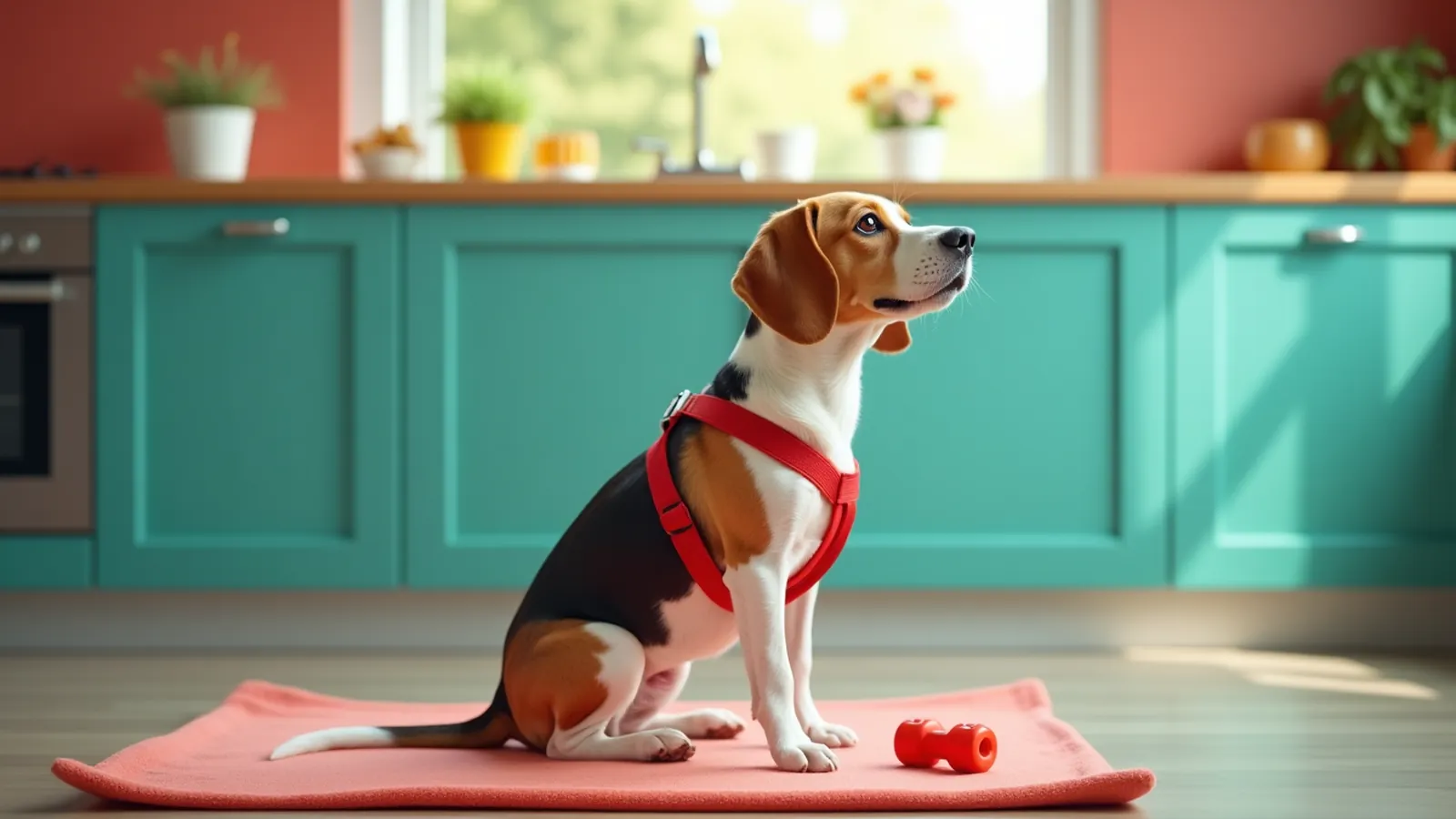
Teach a relaxed settle on a bed or mat
The RSPCA starts with your dog staying in their bed while you are present, then rewarding as you move a little further away and for a little longer. VCA says a dog who can't settle while you are home is unlikely to settle when you leave. Give a long-lasting chew; the RSPCA notes that a dog who leaves a treat they would normally enjoy is telling you they are worried.
Move on when: your dog stays relaxed on the bed while you walk around the room.
Take the meaning out of departure cues
If keys, shoes or a coat set your dog off, pick them up and then sit down and watch TV instead of leaving, as the ASPCA suggests. Sources disagree on how often: the ASPCA says many times a day for many weeks, while VCA suggests only three to four repetitions a day, each time waiting until your dog is calm. Start with fewer and watch your dog.
Move on when: your dog stays calm while you pick up your keys.
Practise out of sight at inside doors
Ask your dog to stay and step behind the bathroom door, then a bedroom door, then an exit door, gradually increasing the time out of sight (ASPCA). If you usually leave by the front door, practice at the back door first. Keep comings and goings calm and quiet.
Move on when: your dog stays relaxed while you are behind a closed exit door.
Start real absences, measured in seconds
The ASPCA starts with absences of only one to two seconds. When you reach five to 10 seconds, add a food-stuffed toy just before you step out. Increase the time by only a few seconds each session, or every couple of sessions. The ASPCA says most anxious responses happen within the first 40 minutes alone, so build slowly up to that, then in larger chunks, at first five minutes, later 15. Vary the lengths: VCA says to increase the time gradually but randomly, and warns against jumping from a five-minute departure to a 30-minute one.
Keep going: at any stress sign, shorten the next absence to a point where your dog can relax, and progress more slowly.
Watch for
A food toy only helps if your dog eats it. The ASPCA says the food approach works only for mild cases, because highly anxious dogs usually won't eat when their guardians aren't home.
Why punishment and "crying it out" make it worse
Punishment is linked with your return, not with the barking or chewing that happened earlier, the RSPCA explains, so your dog becomes more anxious about the next time you leave, and is then more likely to chew or lose toilet control. The RSPCA adds that the "guilty look" is a dog who has been told off before, making itself as small as possible. The ASPCA puts it plainly: anxious behaviors are distress responses, and punishing them may make the problem much worse. AVSAB adds that aversive methods can increase anxiety and fear.
Leaving your dog to "cry it out" fails for a related reason. The ASPCA says it is essential that your dog never experiences the full-blown version of what scares them during treatment; otherwise the dog won't learn to feel calm, and the procedure can backfire. Every long, panicky absence undoes the short, calm ones. That is why the cover arrangements in step 1 matter as much as the training itself.
Coming home to a mess? VCA says to avoid both punishment and excited greetings. Stay calm and let your dog outside before you clean up, as the RSPCA suggests.
Set your dog up for calmer absences
- Exercise first. The RSPCA suggests a walk that ends about half an hour before you leave, a small meal and a toilet trip.
- Keep a special toy for alone time. Give a stuffed food toy only when you leave and put it away when you return (RSPCA, ASPCA).
- Use the crate with care. The ASPCA says a crate helps some dogs but adds stress for others; heavy panting, drooling, frantic escape attempts or persistent barking mean it isn't right for your dog. VCA warns that crates can promote intense escape attempts and serious injuries in dogs with separation anxiety. A room behind a baby gate is an alternative. If your dog already loves a crate, see the step-by-step crate guide.
- Keep total time sensible. Even for a dog who copes, the RSPCA advises leaving a dog no longer than four hours.
A recently adopted dog barks and scratches at the front door within two minutes of the owner leaving for work. The video shows pacing starting when the owner picks up the car keys. The owner books a vet check and arranges daycare on workdays. At home, the dog learns to settle on a mat with a chew, the keys are picked up and put down a few times a day, and out-of-sight stays move from the bathroom door to the back door. The first real exits last two seconds. When the video shows panting at 45 seconds one evening, the next session drops back to 20. Progress is uneven, and that is normal.
Troubleshooting
- If your dog gets anxious before you even leave
- Work on departure cues (step 4) before any absence, and do your getting-ready out of sight where you can, as VCA suggests.
- If your dog won't touch the food toy when you go
- The absence is too long, or the anxiety too high for food to help (ASPCA). Shorten the time; if your dog never eats alone, talk to your vet.
- If progress stalls or slides back
- Go back to the last length your dog handled calmly, and check that no long absences are slipping in between sessions.
- If barking happens whether you are home or not
- It may not be separation anxiety. Check the table above, and see house training an older dog if accidents are the main problem.
When to get professional help
Stop and call for help if
- Your dog injures themselves: broken teeth, cut or scraped paws or damaged nails from chewing or digging at exits (ASPCA).
- Your dog panics within minutes, tries frantically to escape, or destroys doors and windows.
- Your dog soils the house only when alone, or won't eat at all when alone.
- Training stalls, or your dog can't cope with even a few seconds out of sight.
Who to call. Start with your veterinarian: pain, illness and medication side effects can all show up as behavior changes. For behavior problems, look for a board-certified veterinary behaviorist (ACVB directory), a certified applied animal behaviorist, or a certified behavior consultant, for example through the IAABC or the CCPDT directories. Ask any trainer which methods they use; reward-based is what the American Veterinary Society of Animal Behavior recommends.
The ASPCA says desensitization for moderate to severe cases is complex and needs the guidance of a trained and experienced professional, such as a board-certified veterinary behaviorist or a certified applied animal behaviorist. Medication is sometimes part of a veterinarian's plan: the ASPCA says some dogs are so distressed that treatment can't work without it, and AVSAB says such dogs should always be evaluated by a veterinarian. Never give your dog any medication or supplement for anxiety without your vet's advice.
Frequently asked questions
How long does separation anxiety training take?
There is no fixed time. The ASPCA says each dog reacts differently, so there are no standard timelines, and that many owners make the mistake of moving too fast. Progress is measured in seconds at first. Move on only when your dog is relaxed at the current length, and expect some steps back.
Should I crate a dog with separation anxiety?
Only if your dog is truly relaxed in the crate. The ASPCA says a crate helps some dogs but causes added stress for others, and VCA warns that crates can lead to intense escape attempts and serious injuries in dogs with separation anxiety. A safe room behind a baby gate is often a better choice.
Will getting a second dog help?
Not reliably. VCA says that only on rare occasions does a second pet help keep a dog occupied, and that it is unlikely to help a dog who is too anxious. The ASPCA notes that many dogs with separation anxiety are fine as long as a person is with them, which is why a sitter or family member works during training.
Sources
- Separation Anxiety, ASPCA (accessed October 27, 2026).
- How to Train Your Dog to Stay Home Alone, RSPCA (accessed October 27, 2026).
- Separation Anxiety in Dogs, Debra Horwitz, DVM, DACVB and Gary Landsberg, DVM, DACVB, VCA Animal Hospitals (accessed October 27, 2026).
- Position Statement on Humane Dog Training, American Veterinary Society of Animal Behavior, 2021 (accessed October 27, 2026).
- Developing Diagnostic Frameworks in Veterinary Behavioral Medicine: Disambiguating Separation Related Problems in Dogs, de Assis et al., Frontiers in Veterinary Science, 2020 (accessed October 27, 2026).
Settling an adopted dog? Start here
The first days, house training, alone time and building trust, in the order that matters for a rescue dog.