
Rescue Dog
How to house train an older dog, even one who won't go out the door
A puddle just inside the back door, and a dog who freezes at the threshold? Start with a vet check, then a schedule, then small steps that make the doorway feel safe.
On this page (11 sections)
- Why older and rescue dogs have accidents
- When your rescue dog won't go through the door to the yard
- A house training schedule for an older dog
- How to house train an older dog: the daily routine
- If your older dog is a senior
- If your dog dribbles when greeted
- Troubleshooting
- When to get professional help
- Frequently asked questions
- Keep going
- Sources
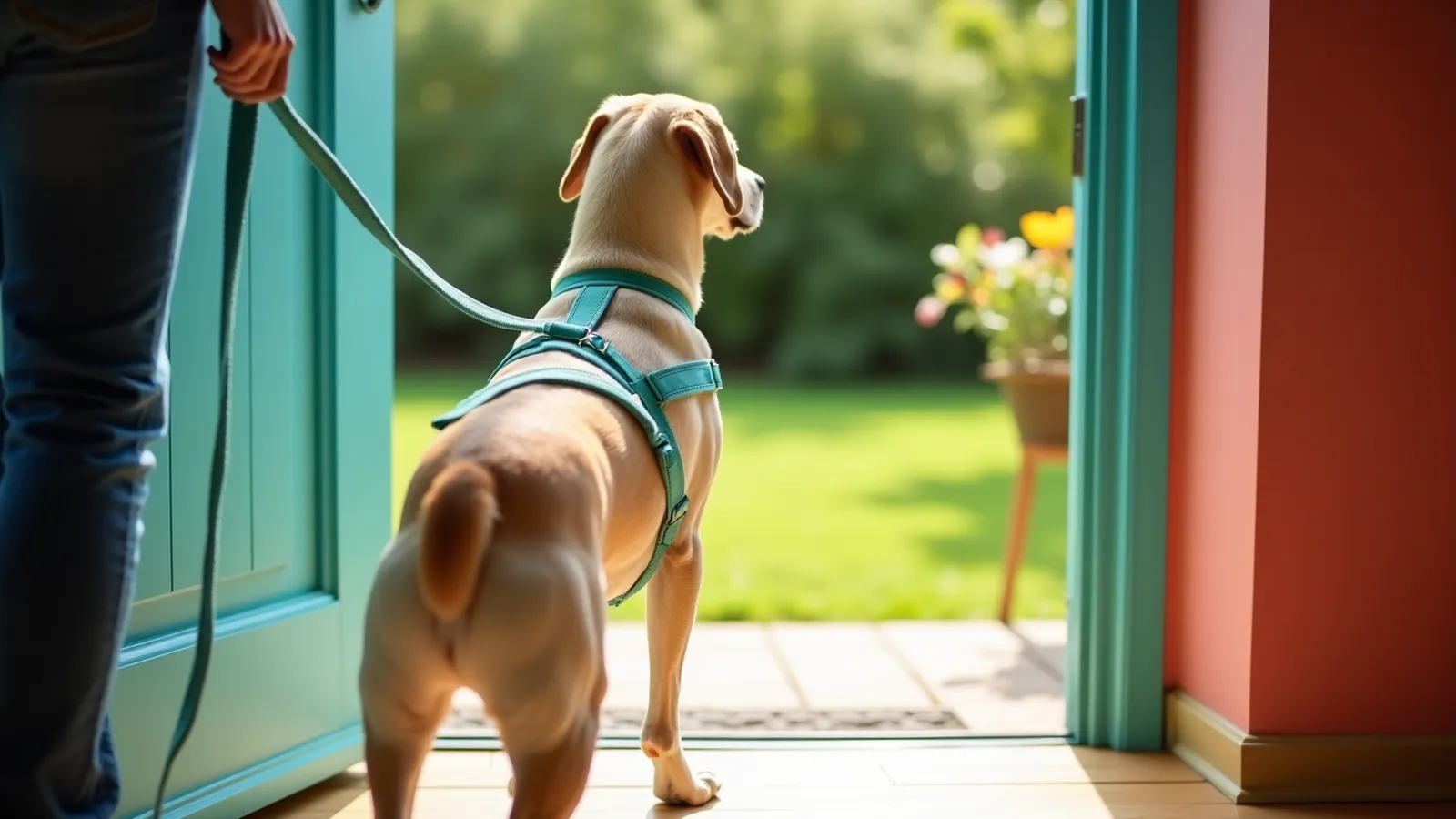
If your rescue dog won't step through the door to the yard, holds it for hours, and then has an accident just inside the door, the problem may well be fear of the doorway or the yard rather than a dog who can't learn. Learning how to house train an older dog starts the same way as with a puppy: the SF SPCA suggests treating a newly adopted adult like a puppy for the first weeks, with a timed schedule, trips on leash, a reward the moment they go outside, and close supervision indoors.
New puppy instead? Start with the puppy potty training schedule; come back to the doorway plan only if your puppy freezes at the door.
Mopping a puddle by the back door before work, again, is draining, and you haven't failed your dog. If you have started to wonder whether you can keep this dog, that is a sign to make the steps smaller, not to give up. Dogs Trust says adult dogs with no previous house training may take longer to change their habits, and that even fully trained dogs have accidents when settling into a new home. The plan below follows VCA Animal Hospitals' veterinary behaviorists, the SF SPCA, Dogs Trust, the RSPCA and Best Friends Animal Society.
Key takeaways
- A sudden change in a house-trained dog means a vet visit first.
- For a new adult dog, start like a puppy: trips first thing, after meals, sleep and play, every two hours or so, and last thing at night.
- Go out with your dog, on leash, and reward the moment they finish outside.
- A dog who won't go through the door isn't being stubborn. VCA says don't scold or force; make the doorway safe in small steps.
- Never punish accidents. Clean them with an enzymatic cleaner and supervise more closely.
Was your dog already house-trained? See your vet first
If an adult dog who was reliably clean starts having accidents, especially suddenly, VCA says to ask your veterinarian to check for a physical illness before retraining. Dogs Trust says accidents in a trained dog are often due to a medical issue, and lists urinary tract infections, bladder stones and kidney disease among common causes. A dog in pain may also find going outside harder. Retrain after the vet visit, not instead of it.
Do this today
- If your dog was house-trained before, book the vet check.
- Write the trip times from the schedule below on a note by the door.
- Scatter a few treats by the closed back door and walk away: that is doorway step one.
Why older and rescue dogs have accidents
VCA's behaviorists say the cause can almost always be found with a little detective work. Match what you see to the likely cause first.
| What you see | Likely cause | First step |
|---|---|---|
| Accidents on and off since adoption | Never fully house-trained (VCA) | Restart as if your dog were a young puppy |
| A clean dog starts going indoors | Medical issue, pain, or a change at home (Dogs Trust, VCA) | Vet check before retraining |
| Won't go out, or won't go once outside | Fear: VCA says a frightened dog may be too distracted to eliminate | The doorway plan below |
| Accidents only when left alone | Separation-related stress (Dogs Trust) | A separation plan; see help section |
| Small amounts on walls or furniture | Scent marking (Dogs Trust, VCA) | Clean thoroughly; talk to your vet |
| Dribbling when greeted or reached for | Submissive or excitement urination (SF SPCA) | Vet check, then calm greetings |
| An older dog seems confused | Ageing (Dogs Trust, VCA) | Vet check; see the senior section |
When your rescue dog won't go through the door to the yard
VCA's behaviorists say a fearful dog may cower, retreat, tremble or refuse to move, that the dog is not being stubborn, and that you should not scold or force her forward. Instead, use desensitization: start at a level so low your dog stays relaxed, pair it with treats, and increase it gradually (VCA). Practise at calm times, separate from urgent toilet trips.
Look for the trigger
VCA suggests trying to identify what triggered the fear. It might be the step, a slippery floor, a noisy neighbor's dog or the open yard.
Move on when: you have a guess, and a quieter time of day to practice.
Make the doorway a treat spot
With the door closed, scatter a few treats near it and walk away. Then feed meals or treats a little closer to the door over several sessions.
Move on when: your dog eats happily right by the closed door.
Open the door, nothing more
Open it, drop treats on the threshold, and let your dog choose to come and get them. Don't call or pull; VCA says not to force a fearful dog forward.
Move on when: your dog walks up to the open doorway without hesitating.
One step out, then back in
Put the lead on, step out together, toss a treat just outside, and come straight back in while your dog is still relaxed. Dogs Trust suggests keeping your dog on the lead even in the garden until they have been, which also keeps a worried dog close.
Move on when: your dog steps out readily for a treat.
Bring the toilet spot close
Choose a spot a few steps from the door so the trip is short. VCA suggests creating a sheltered elimination area where your dog won't meet the fear triggers. Wait quietly, and reward as soon as your dog finishes.
Keep going: lengthen the time outside gradually, only as fast as your dog stays relaxed.
Signs to slow down: refusing treats, trembling, stalling or trying to get back inside. VCA says refusing food treats is one sign of fear, and that exposure that is too fast can make the fear worse. Go back a step. If the yard itself is the problem, Dogs Trust's toilet routine allows either the garden or a short walk, so try a calm on-leash walk from the front door while you work on the yard.
Why the puddle is by the door
Dogs Trust lists hanging around the door to outside among the signs a dog needs to go. A dog who goes just inside the door may have been asking, or may have wanted to go but been too worried to step out. Watch the door, and clean that spot with an enzymatic cleaner; Best Friends explains that urine carries scent markers that draw dogs back to the same place.
A house training schedule for an older dog
Dogs Trust suggests aiming for a predictable schedule over the next few weeks. Adult dogs can usually wait longer than puppies, but not indefinitely: VCA says a healthy adult can usually hold urine for about 3 to 4 hours if not active, and active dogs need to go more often. The SF SPCA notes that the smaller the dog, the less time they can go without a break.
| Moment | What to do | Source |
|---|---|---|
| First thing in the morning | Straight out after waking | SF SPCA, Dogs Trust |
| After meals | Out soon after eating | SF SPCA, Dogs Trust, Best Friends |
| After sleep or a longer nap | Out as soon as they wake | SF SPCA, Dogs Trust, Best Friends |
| After play or a walk, or excitement | Out when it ends | SF SPCA, Dogs Trust |
| In between, while awake | Every two hours to start, later every two to three hours | SF SPCA, Dogs Trust, Best Friends |
| Last thing at night | A final trip right before bed | SF SPCA, Dogs Trust |
Dogs Trust also suggests opening the back door only for toilet breaks rather than leaving it open, so your dog learns to wait. VCA suggests keeping a short journal of when your dog goes, which can reveal a pattern to share with your vet.
Days 1 to 3: the dog is walked on leash from the front door for every toilet trip on the schedule, and gets treats by the closed back door twice a day. Days 4 to 6: the back door opens during treat sessions; the dog takes treats from the threshold, then from the step. Days 7 to 10: one step out together on lead, a treat, back in. A toilet spot is set up beside the step, and the first pee there earns a handful of treats.
How to house train an older dog: the daily routine
Supervise or confine
Until your dog is reliable, the SF SPCA says not to leave them alone unless they are in a dog-proofed area or crate. Best Friends suggests a small, easy-to-clean room with a gate, set up as a comfortable den.
Same spot, on leash
Go together to the same toilet spot (Dogs Trust). Stay calm and quiet, and don't play or fuss until your dog has been (Dogs Trust, Best Friends).
Reward after, not before
Dogs Trust says to give the reward once your dog has finished; reward too early and your dog may forget to finish, which can lead to accidents later.
Handle accidents calmly
If you catch your dog in the act, interrupt without being harsh and take them out to finish (SF SPCA). If you find it later, just clean up quietly (VCA). The SF SPCA says punishment can make a dog afraid to go in front of you, even outside.
Earn freedom room by room
The sources differ. The SF SPCA suggests one extra room after two or three weeks with no accidents, then another every two or three weeks. Best Friends suggests more freedom after about a week without accidents, still supervised. Go at the slower pace if accidents return.
If your dog came from a shelter, the guide to settling a rescue dog in the first days, weeks and months covers the bigger picture.
If your older dog is a senior
See your vet first here too. Dogs Trust notes that a dog with leg pain may find stepping into the garden hard and wee indoors instead, that peeing more is expected with age because of a weaker bladder, and that cognitive decline can make an older dog seem to go backwards in toilet training. It suggests adjusting the toileting routine to your dog's activity levels and sleep times.
If your dog dribbles when greeted
Some dogs leak urine when someone greets them or reaches for them, or during exciting play. The SF SPCA describes two kinds: submissive urination, with cowering or ears back, and excitement urination during greetings and play. VCA says neither is done deliberately. The SF SPCA suggests starting with a vet visit to rule out medical reasons, then:
- Keep greetings low-key, and speak in a calm, low voice.
- Greet and play outdoors until the problem resolves.
- Don't loom over your dog; bend your knees and turn side-on.
- Give your dog something else to do at greetings, such as a sit, then reward it.
- Never scold. The SF SPCA says it only makes the problem worse.
Troubleshooting
- If your dog holds it on walks and goes as soon as you get home
- Your dog may be too distracted or worried outside to go (VCA). Try a quieter route, and give your dog enough time at the spot (Dogs Trust). If they don't go promptly, head back in and supervise closely until the next try (VCA).
- If your dog goes outside but still has accidents indoors
- VCA notes a dog may go when taken out but not yet understand they sometimes have to wait. Shorten the gaps between trips and go back to closer supervision.
- If accidents happen only when you are out
- Dogs Trust says toileting only when alone is likely separation-related. See separation anxiety training.
When to get professional help
Stop and call for help if
- A dog who was house-trained starts soiling, especially suddenly: vet first, as VCA and Dogs Trust advise. VCA adds that your vet may suggest a veterinary behaviorist.
- Your dog trembles, cowers or panics at the door and doesn't improve with small steps. VCA suggests a qualified animal behaviorist or skilled positive reinforcement trainer to set the right pace.
- Your dog toilets only when left alone, or seems distressed when you leave (Dogs Trust).
- An older dog seems confused or uncomfortable (Dogs Trust).
Who to call. Start with your veterinarian: pain, illness and medication side effects can all show up as behavior changes. For behavior problems, look for a board-certified veterinary behaviorist (ACVB directory), a certified applied animal behaviorist, or a certified behavior consultant, for example through the IAABC or the CCPDT directories. Ask any trainer which methods they use; reward-based is what the American Veterinary Society of Animal Behavior recommends.
Frequently asked questions
How long does it take to house train an older dog?
There is no fixed timeline. Best Friends says house training can take days to weeks, Dogs Trust says adults with no previous house training may take longer to change their habits. A dog frightened of the yard needs extra time for the doorway steps.
Is it hard to potty train an adult dog?
Not usually. The RSPCA says the stages are the same as for a puppy, though it may take longer, and Dogs Trust says most dogs can learn quickly where to go in a new home. The hard part is staying consistent with the schedule and supervision.
How do I stop my older dog peeing and pooping in the house?
Start with a vet check, especially if the change was sudden. Then go back to basics: frequent trips on leash, a reward after each success outside, close supervision or a safe confined area indoors, and thorough cleaning of old spots with an enzymatic cleaner (Dogs Trust, VCA, SF SPCA).
Should I crate an adult dog during house training?
A crate or a dog-proofed area helps when you can't supervise, as the SF SPCA describes, as long as your dog is comfortable in it and the time is short. If your dog isn't used to a crate, introduce it gradually; the crate training steps work at any age.
Sources
- Dog: House-Training Your Adult Dog, San Francisco SPCA (accessed October 27, 2026).
- Why Toilet-Trained Dogs Have Accidents, Dogs Trust (accessed October 27, 2026).
- Dog Behavior Problems: House Soiling, VCA Animal Hospitals (accessed October 27, 2026).
- Fear of Places in Dogs, Ellen Lindell, VMD, DACVB; Kenneth Martin, DVM, DACVB; Debra Horwitz, DVM, DACVB and Gary Landsberg, DVM, DACVB, VCA Animal Hospitals (accessed October 27, 2026).
- Submissive and Excitement Urination, San Francisco SPCA (accessed October 27, 2026).
- How to Toilet Train Your Puppy, Dogs Trust (accessed October 27, 2026).
- How to Potty Train a Puppy or Dog, Best Friends Animal Society (accessed October 27, 2026).
- Toilet Training Your Dog, RSPCA (accessed October 27, 2026).
Just adopted? Start here
Settling an adopted dog, from the first days to the first months: decompression, routines, alone time and house training.