
New Puppy
Puppy chewing: a redirection plan that protects your furniture
If your puppy ignores the toy pile and heads straight for the chair leg, the fix is a routine, not a better toy. Here is the rotation, the tether-and-redirect plan and the room-by-room checklist that make the right thing easier to chew.

On this page (11 sections)
- Puppy chewing: why the chair leg wins
- Step one: a chew-toy rotation
- Step two: the tether-and-redirect routine
- Step three: the room-by-room management checklist
- Troubleshooting: when the plan stalls
- When there is also a rescue dog in the house
- If you are wondering whether a paid puppy program is worth it
- When to get professional help
- Frequently asked questions
- Keep going
- Sources
The chew toys are in a pile. Your puppy walks past every one of them and settles down on the chair leg, the baseboard, or the one shoe you left by the door, and it happens the moment your attention goes back to your laptop. The trail of chewed bits is demoralizing, and it is easy to read it as proof that you are already failing this puppy.
You are not failing, and the answer is not a better toy. It is a routine that makes the right thing easier to chew than the wrong thing, so your puppy stops practicing furniture chewing while the habit is still small. Below is a chew-toy rotation, a tether-and-redirect routine for the hours you are working, and a room-by-room management checklist. If there is also a rescue dog in the house, the two-dog section near the end keeps the two plans separate.
Key takeaways
- Decide what gets chewed. Block the furniture, keep good chews within reach, and supervise. Management is half the plan, not a shortcut.
- Rotate: a few chews out, the rest in a box, swapped when interest fades. This is a management suggestion, not a fixed schedule.
- Tether with a flat harness, never a collar, and stay in the room.
- Reward the chew, trade for the shoe, skip the scolding. AVSAB's humane training position supports reward-based training and advises against aversive methods.
- Clear the floor room by room. A puppy cannot chew what is not there.
- Destruction that only happens when you are out is a being-alone problem, not a chewing problem.
- Swallowed toy pieces or a chewed cable: call your veterinarian.
Do this today
- Clear the floor of the one room you use most: shoes into a closet, cables tucked, clutter off the floor.
- Put three or four chews out and the rest in a box. That box is the rotation.
- Set a tether point or a pen beside your desk: flat harness, light leash, a chew within reach. Never a collar.
Puppy chewing: why the chair leg wins
A chair leg is always there. It does not get put away, it never loses its squeaker, and it feels the same every day. A chew that has been on the floor for a week has become furniture too. That is why the pile of toys loses: your puppy is not choosing badly, they are choosing what is available and interesting.
You will not train a puppy out of chewing. What you can change is what is within reach, what pays off, and what your puppy does instead. So the plan has three parts that work together: a rotation so the chews you offer are worth choosing, a tether-and-redirect routine so furniture chewing never gets practiced, and a room-by-room checklist so the room does most of the work.
None of it uses scolding, leash jerks, muzzle grabs, sprays or other corrections that work by startling or hurting a puppy. AVSAB's Position Statement on Humane Dog Training supports reward-based training and advises against methods that rely on fear or pain. The practical version here is simple: reward the chew you want, manage the furniture you do not, and keep each session short enough that your puppy can succeed.
Watch for
If your puppy is calm when watched and destructive only when left alone, treat that as a being-alone problem rather than a chewing problem. The separation-related problems literature notes that the signs dogs show when left alone can reflect fear, frustration or panic associated with being separated from an attachment figure. Start with your veterinarian, then read our guide to separation anxiety training.
Step one: a chew-toy rotation
Rotation is the cheapest fix on this page, and it is a management suggestion from this site rather than a rule from a study. Keep most chews in a box out of reach and only three or four out at a time. When the ones on the floor stop getting picked up, put them away and bring out different ones. To your puppy they feel new again, and you have spent nothing. There is no set number of days for a swap; every dog is different, so change them when interest fades rather than on a calendar.
Match the chew to the moment. A firmer rubber toy suits settled chewing beside your desk, a softer toy suits a young mouth, a food-stuffed toy suits the pen or crate, and a frozen stuffed toy buys you a longer stretch when you need one. Texture matters more than brand: try rubber, rope, fabric and hard rubber one at a time and notice which ones your puppy actually picks up. Keep your best chews out of general circulation, so the most interesting thing in the house is always something your puppy is allowed to have.
Before anything goes into the rotation, run the same check every time: too large to swallow whole, no loose squeakers, eyes, bells or rope ends that can pull off, nothing cracked or torn, and anything damaged leaves the rotation for good. Give edible chews under supervision and ask your veterinarian which types and sizes suit your puppy's age and mouth, because this site does not give medical or dietary advice. If you want to add a few toys, here is a search for puppy chew toys (Amazon, affiliate link) opens in a new tab; choose by the check above rather than by the label on the packet.
Save the best chews for the moments that matter: your working hours, the pen, the car, the evening slump. A chew that is always lying around is a chew that stops being interesting, which is exactly how the chair leg got the job in the first place.
Step two: the tether-and-redirect routine
This is the part that stops the rehearsal. A puppy loose in a room with a chair leg is practicing furniture chewing; a puppy beside you with a chew is practicing the choice you want. This is the routine for a working day, and it works just as well at the weekend.
Set up where you actually are
Put a pen or a gate in the room where you work, or set a tether point beside your desk. Clear the floor first, and keep the crate open nearby so your puppy can choose it for a nap.
Tether safely
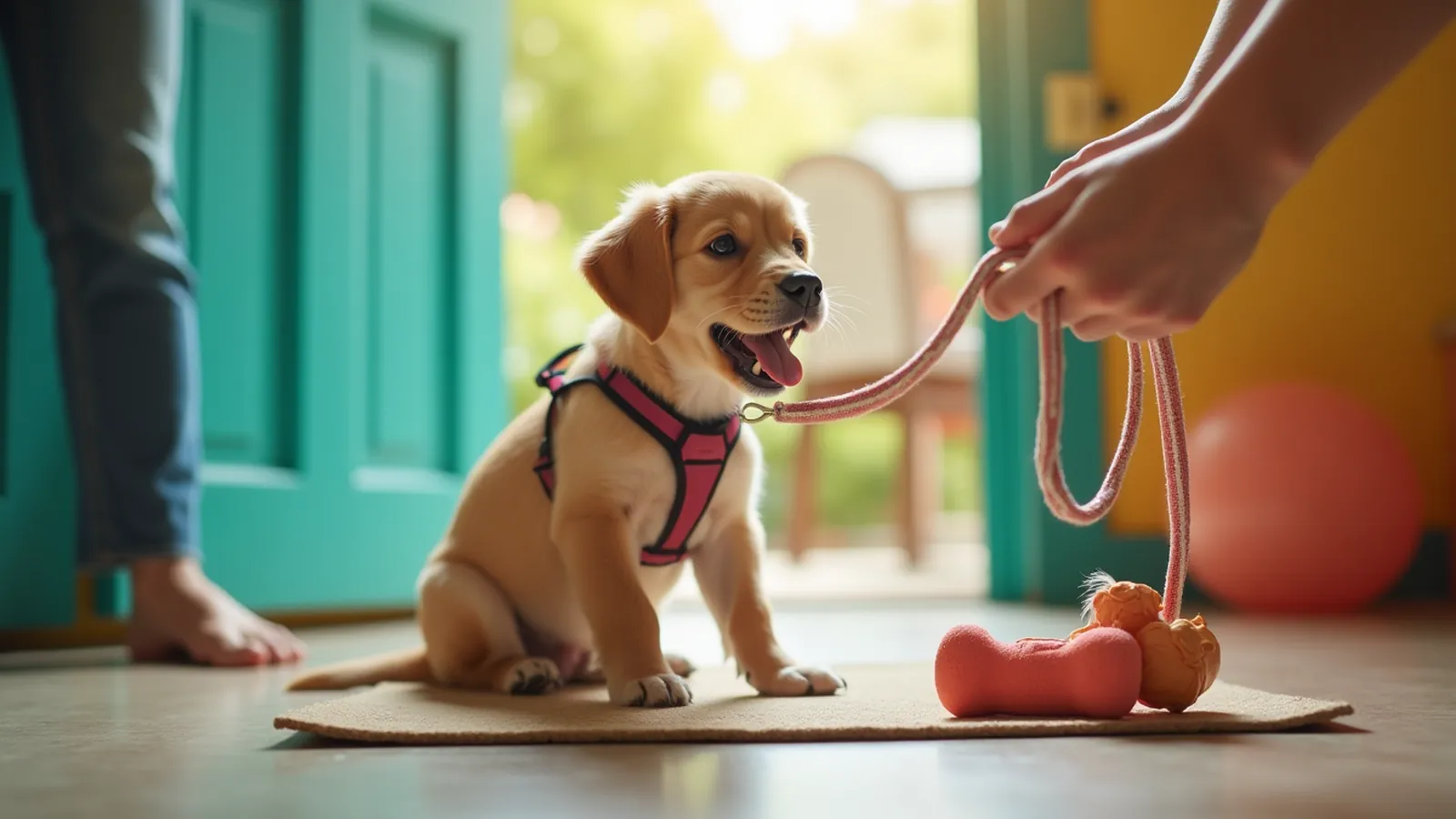
Use a flat harness, never a collar, and a light leash clipped to your belt loop or to a solid piece of furniture that cannot tip. Stay in the room, untangle the leash when it wraps, and never leave a tethered puppy alone or tether one dog near another.
Keep the chew and the treats within reach
Approved chews on the floor beside you and a small pot of treats in your pocket. If you have to stand up and search, you will be too slow, and the chair leg wins.
Reward the choice, quietly
When your puppy picks up a chew, say a calm yes and drop a treat on the floor next to it. Do not take the chew away to reward it; you want the toy to stay in the mouth. Choosing the toy has to pay.
Interrupt before contact
When your puppy turns toward the furniture, say their name or make a light kissing noise, then roll a toy away from the chair. You are moving the feet and the mouth, not correcting the puppy. No leash jerks, shouting, muzzle holding or nose rubbing.
Swap, do not snatch
If your puppy already has the shoe, the remote or a sock, trade. Hold a treat at the nose, take the item when the mouth opens, then hand over a chew. Snatching teaches a puppy to run off with the prize; trading teaches the opposite.
End on a rest
If chewing, snatching and biting at your hands escalate, the session is over: pen or crate with a chew, lights low, quiet. An earlier rest period often helps more than another training round. Our guide to crate training a puppy covers settling, and the puppy biting guide covers mouth-on-hands.
What good looks like: your puppy takes the toy from your hand, settles with it for a stretch, then gets up and looks around. If the next thing they do is pick up another toy, you are winning. If they head for a leg of the desk, you interrupt and swap. That is a normal day, not a failure.
Earning freedom back: when your puppy reliably chooses a chew during supervised time in one room, try a short stretch off the tether with toys already out on the floor. If they head for the furniture, back on the tether and try again later. Build room by room, not the whole house at once, and keep the gates in place while the habit is still forming. There is no fixed timeline for this and progress is rarely a straight line.
Step three: the room-by-room management checklist
Management is not cheating. It is how you stop a puppy rehearsing a habit while the training catches up. Work through this list once, properly, and most of the daily destruction stops before you have taught anything at all.
| Room | Clear or block | Leave within reach |
|---|---|---|
| Living room | Gate it when you cannot watch. Tuck cables into a cover, clear the coffee table, move the good cushions | A mat with chews and a stuffed toy |
| Home office | Cable tidy on every lead, bin with a lid, nothing on the floor under the desk | Tether point, chew mat, treat pot |
| Bedroom | Shoes and slippers in a closed closet, laundry basket with a lid, nothing drying at puppy height | A chew by the bed for mornings |
| Kitchen | Bin with a locking lid, dishwasher shut, dish towels out of reach, cleaning products locked away | A chew mat where the family eats |
| Hallway and entry | Shoes on a rack above puppy height or behind a door, bags hung up, door mats lifted if they get chewed | A chew by the door for coming-home moments |
| Bathroom and laundry | Door closed. Toilet roll out of reach, laundry pods locked away, waste bin with a lid | Nothing needed; keep it shut |
For wooden furniture legs specifically: block them while the toy habit gets stronger. A section of playpen panel, a plastic cable cover or an old towel taped around the leg is ugly and effective. Put a chew mat right beside the blocked leg and reward every choice of the mat over the wood. That is the management half of how to stop a puppy from chewing on furniture legs; the reward half is the tether routine above. It also helps to give the leg a different job: a squeeze of pet-safe food paste on a lick mat fixed to a nearby surface gives the puppy something to do in the same corner that is not the wood.
Troubleshooting: when the plan stalls
- If your puppy goes straight for the wooden furniture legs
- Block the legs first, then reward the alternative. Add sniffing or scatter-feeding games to the day so there is more to do than furniture, and keep sessions short and frequent rather than one long one.
- If your puppy ignores every toy you offer
- Check the rotation first, then try food-stuffed and frozen options, and try a different texture. Some puppies need to see a toy move or be tugged before they want it: give it a short, lively game, then let them have it.
- If your puppy destroys every toy and eats the pieces
- Take that toy away for good and choose firmer options that are only used under supervision. If your puppy has swallowed toy, rope, fabric or anything that is not food, call your veterinarian.
- If chewing and mouthing escalate in the evening
- Try bringing the last nap forward and giving a chew in the pen. An earlier rest period often helps more than another training round, and a calm, dim room does more for a wound-up puppy than a new toy.
- If it only happens when you leave
- Stop treating it as chewing and treat it as a being-alone problem. See the callout above, read our guide to separation anxiety training, and speak to your veterinarian before you run any training plan.
- If your puppy has started chewing walls, stones or other non-food items
- That is a conversation for your veterinarian, not a training plan. Book an appointment and describe exactly what your puppy is eating and how often.
When there is also a rescue dog in the house
Two dogs at different stages need two separate plans, and the chewing plan belongs to the puppy. Keep the rescue dog's routine as steady as you can while you manage the puppy's mouth.
- Separate chew zones. The puppy chews on its mat or in its pen; the rescue dog chews where it always has. Pick up loose chews when both dogs are in the same room, so neither dog has to defend one.
- Give the rescue dog a puppy-free room. A gate the puppy cannot pass, a bed the puppy cannot reach and undisturbed rest give the older dog somewhere to settle away from the puppy.
- Supervise or separate. Do not leave a puppy loose with a resident dog, and never leave both dogs together with food or high-value chews.
- Expect slow, uneven progress. Best Friends notes that dogs from puppy mills, and rescues with a deprived or stressful start, recover at very different rates, that rehabilitation can take weeks, months or even years, and that steps forward are often mixed with steps backward. For a newly adopted dog, the 3-3-3 rule for rescue dogs sets out the settling timeline in ranges, not deadlines.
A puppy is tethered beside a desk with a stuffed chew while the person finishes work. The rescue dog is behind a gate in the next room with its own chew and a bed. When work ends, the puppy goes into the pen for a nap, the gate opens, and the rescue dog gets a walk on its own. Nothing is shared, nothing is left on the floor, and nobody has to be corrected.
If you are wondering whether a paid puppy program is worth it
If you have already watched a dozen videos and paid for a class and the chair leg is still winning, the skepticism is reasonable. A course can add structure and video demonstrations. It cannot be in your room with your furniture or your two dogs. That is why the free plan above comes first, and why the honest test of any program is whether it gives you a specific routine like this one, rather than a promise of a fast result.
The Online Dog Trainer's Puppy Coach program, as listed on its site on October 27, 2026, describes a video diary following one puppy from 8 weeks to 8 months, covering chew toys, crate training, toilet training, socialization, basic commands, managing separation anxiety, recall and leash training, plus material on puppy nutrition, exercise, health and safety. That is the vendor's own description. We have no affiliate relationship with The Online Dog Trainer today, and we earn nothing if you buy. If that changes, this sentence and the links will say so. You can read it here: The Online Dog Trainer's Puppy Coach program (opens in a new tab).
Free alternatives first: the guides on this site, a local force-free puppy class, your veterinarian for anything medical, and a qualified behavior professional if the problem is bigger than chewing. Treat any promise of a fixed result in a set number of days as a marketing line rather than a plan, and check whether a program describes what to do in your house, with your dogs, at your stage.
When to get professional help
Stop and call for help if
- Your puppy swallows pieces of toy, rope, fabric or anything that is not food, or chews through an electrical cable. Call your veterinarian straight away.
- The destruction only happens when your puppy is alone and your puppy seems panicked or cannot settle. Speak to your veterinarian before starting any training plan.
- Any dog in the house growls, snaps or guards a chew, a bed or a person. Do not test it and do not train through it.
- Your rescue dog's behavior changes suddenly, or fear in the adult dog gets worse rather than better.
- You are exhausted, worried about money, or starting to think about rehoming. That is a reason to ask for help early, not a reason to feel judged.
Who to call. Start with your veterinarian: pain, illness and medication side effects can all show up as behavior changes. For behavior problems, look for a board-certified veterinary behaviorist (ACVB directory), a certified applied animal behaviorist, or a certified behavior consultant, for example through the IAABC or the CCPDT directories. Ask any trainer which methods they use; reward-based is what the American Veterinary Society of Animal Behavior recommends.
Good Dog Basics is not a veterinary practice or a behavior service, and nothing here replaces an exam or an in-person assessment. This page is written with AI-assisted drafting and fact-checked against the sources listed at the bottom, which you can read for yourself (see how we write).
Frequently asked questions
How do I stop a puppy from chewing on furniture legs or wood furniture?
Block the leg so it cannot be chewed when you are not watching, and put a chew mat beside it that pays well. Tether your puppy to you while you work, reward every choice of the mat, and trade rather than snatch when your puppy already has the wood. The habit fades when the leg stops being available and the chew keeps being rewarded.
How do I stop a puppy from chewing on everything?
You cannot puppy-proof the whole world, so shrink the world for a while. Clear the floor of the rooms you use, close doors, gate what you cannot clear, and supervise with a tether or a pen. A puppy with fewer things to chew and a few good chews within reach will choose better, simply because there is less to choose from.
How do I stop a puppy from chewing in general?
Decide what is allowed and make it easy to reach, then make everything else harder to reach. Rotate chews so they stay interesting, reward your puppy for picking one up, and interrupt before teeth touch the furniture rather than after. Scolding is not part of this plan; it teaches a puppy to chew out of sight instead.
Why does my puppy ignore the chew toys I bought?
Usually because they have been on the floor for days and have become furniture too. Rotate them: a few out, the rest in a box, swapped when interest fades. Then check texture and movement. Food-stuffed and frozen toys, and a short tug game with you, often turn a boring toy into the best thing in the room.
Should I scold my puppy for chewing?
This site does not use scolding. AVSAB's humane training position supports reward-based methods and advises against aversive corrections. Block the furniture, reward the chew, and swap calmly when your puppy already has the wrong thing in their mouth. That plan is clearer for the puppy and far easier for you to repeat on a tired Tuesday.
Sources
- Position Statement on Humane Dog Training, American Veterinary Society of Animal Behavior (accessed October 29, 2026).
- Separation Related Problems in Dogs, PubMed Central (accessed October 29, 2026).
- What to Expect When Rescuing a Puppy Mill Dog, Best Friends Animal Society (accessed October 29, 2026).
- The Puppy Coach Training Program, The Online Dog Trainer (the vendor's own page; accessed October 29, 2026).
New puppy? Start here
The first weeks in the order that matters: sleep, toilet trips, the crate, biting and what to give a puppy to chew.