
New Puppy
Afraid of ruining your puppy? What actually matters
When every training decision feels permanent, it helps to know which mistakes shape a dog and which ones you can repair later. Here is the short list that matters, the long list that does not, and a daily checklist that lowers the stakes.
On this page (14 sections)
- Afraid of ruining your puppy: what this fear gets right
- What matters a lot
- What you can fix later
- Puppy biting and leash pulling: skills, not character
- Crate training at night: what to do when the puppy cries at 2 a.m.
- House-training accidents on the rug, and rescue regression when a puppy arrives
- A daily checklist for raising a puppy without the fear
- Raising a puppy and a rescue dog in the same house
- If you have already tried YouTube and a puppy class
- When you freeze mid-training: a three-question reset
- When to get professional help
- Frequently asked questions
- Keep going
- Sources
If you are afraid of ruining your puppy, the freeze usually lands mid-session: treat in hand, puppy bouncing at your knees, and a mental replay of every forum warning about adolescent dogs who turned leash-reactive because someone rewarded a jump. So you stop, unsure whether the next click helps or harms. That is not a training problem. It is a sorting problem, and sorting has a fix.
Raising a puppy is not one long exam you can fail. A short list of things carries real weight: safe early experiences, humane methods, protecting your dog from overwhelm, and fast help for fear or aggression. A much longer list, including a late hand signal, a missed week of practice and a clumsy first try at loose-leash walking, can be taught later. Putting each worry into one of those two piles is what stops a decision from feeling high-stakes.
With a puppy and a rescue in the same house, the pressure doubles, because one dog is new to everything and the other has a history you cannot see. A hard night is not a verdict on either of them. It is information about what support to add next.
Key takeaways
- Two piles: things that matter a lot, and things you can repair later. Most of your worries are in the second pile.
- What matters: safe early experiences, reward-based methods, protection from overwhelm, and early help for fear or aggression.
- Socialization is wider than greeting people and dogs. Best Friends Animal Society describes it as comfort with everyday objects and events too, such as stairs and doorways.
- AVSAB's position statement on humane dog training recommends reward-based training. This site uses reward-based methods only: no shock, prong or choke collars, and no alpha rolls or dominance-style corrections.
- Panic at being left alone is not a manners problem. A review of separation-related problems describes fear, frustration and panic as part of the picture, with no single diagnostic test.
- Night crying and rug accidents are routine problems with routines attached. They are not signs that your puppy is broken.
Do this today
- Pick one skill and one small step, and reward three easy repetitions.
- Add one calm, optional new experience, if your veterinarian says outings are safe.
- Write tomorrow's next small step on your phone, so you are not deciding under pressure at 2 a.m.
Afraid of ruining your puppy: what this fear gets right
When the fear is loud, it shows up as paralysis rather than panic. You hold the leash tighter because of a thread about leash reactivity. You skip the class because someone said the floor is unsafe. You end a training game early because you are not sure the treat landed at the right second. None of that makes you careless. It makes you an owner who has been handed too many rules and no order to put them in.
The useful question is not "was that flawless?" It is "which pile does this belong in?" Decisions that shape your dog's sense of safety, and their trust in you, deserve care. Decisions that are simply practice deserve a shrug and another try tomorrow.
What matters a lot
These are the areas where early experience and method carry weight. None of them needs a perfect day. Each needs a pattern.
| Area | Why it carries weight | The low-drama version |
|---|---|---|
| Safe early experiences | Best Friends notes that a dog raised without early positive exposure can stay fearful of ordinary things, such as stairs and doorways. | One calm, optional new experience at your dog's pace. |
| The method you use | AVSAB's 2021 position statement recommends reward-based training and advises against aversive tools and intimidation. | Reward what you want, block what you do not want, and make the step smaller. |
| Fear, guarding or biting | These need a veterinarian and a qualified behavior professional, not another video. | Call early instead of pushing through. |
Notice what is not on that list: a perfectly timed marker, a tidy training log, a puppy who never jumps on a guest. Those are skills, and skills are built through practice, including messy practice. If you want the short version of the rules, how to not ruin your puppy gives you three to hold on to. This page is the reasoning behind them.
What you can fix later
This list should lower your shoulders. These things are not nothing; they are just not permanent. Every dog is different, so treat each row as a starting point, not a deadline.
| Worry | Why it can wait | First move |
|---|---|---|
| A missed day or week | A gap in practice is a gap, not a change in temperament. | Do three easy repetitions today. |
| A cue you taught by accident | A cue is not permanent. You can build a new one. | Say the new word once, reward the behavior, repeat. |
| Jumping up or pulling | Both are skills plus environment, not character flaws. | Reward four paws on the floor, starting somewhere quiet. |
| A rescue who is still wary | Trust is built through predictable, low-pressure routines. | Use the 3-3-3 rule for rescue dogs as a settling-in frame. |
That last row deserves a caution. "Fixable later" does not mean "force it now". Best Friends notes that socialization plans for rescued dogs have to be tailored to the individual, because genetics, past experiences and each dog's capacity to change all differ. It also notes that for some rescued dogs, a socialization push creates distress rather than benefit. You do not have to solve the whole relationship in one weekend.
Puppy biting and leash pulling: skills, not character
These two worries do the most damage to a new owner's confidence, and both are teachable skills with an environment attached.
Puppy biting. Most hard biting spells get worse when a puppy is overtired and when hands stay in the game. Add naps, offer a legal chew, end the game calmly when teeth touch skin, and reward the puppy who settles instead. A puppy who bites is not showing you the adult dog's temperament. A puppy who bites is showing you a puppy who needs sleep and a different outlet.
Leash pulling. A dog who pulls has practiced pulling, usually for weeks, because pulling works: the walk keeps going. That is a reinforcement history, not a personality. Start somewhere boring, pay the check-in, and let a harness help you hold on while you teach the skill.
Jumping up. Same pattern, smaller stakes. Attention is the paycheck, so pay the version you want, with four paws on the floor. None of this is a reason to correct, shout or physically move the dog, and none of it needs to be finished this month.
Crate training at night: what to do when the puppy cries at 2 a.m.
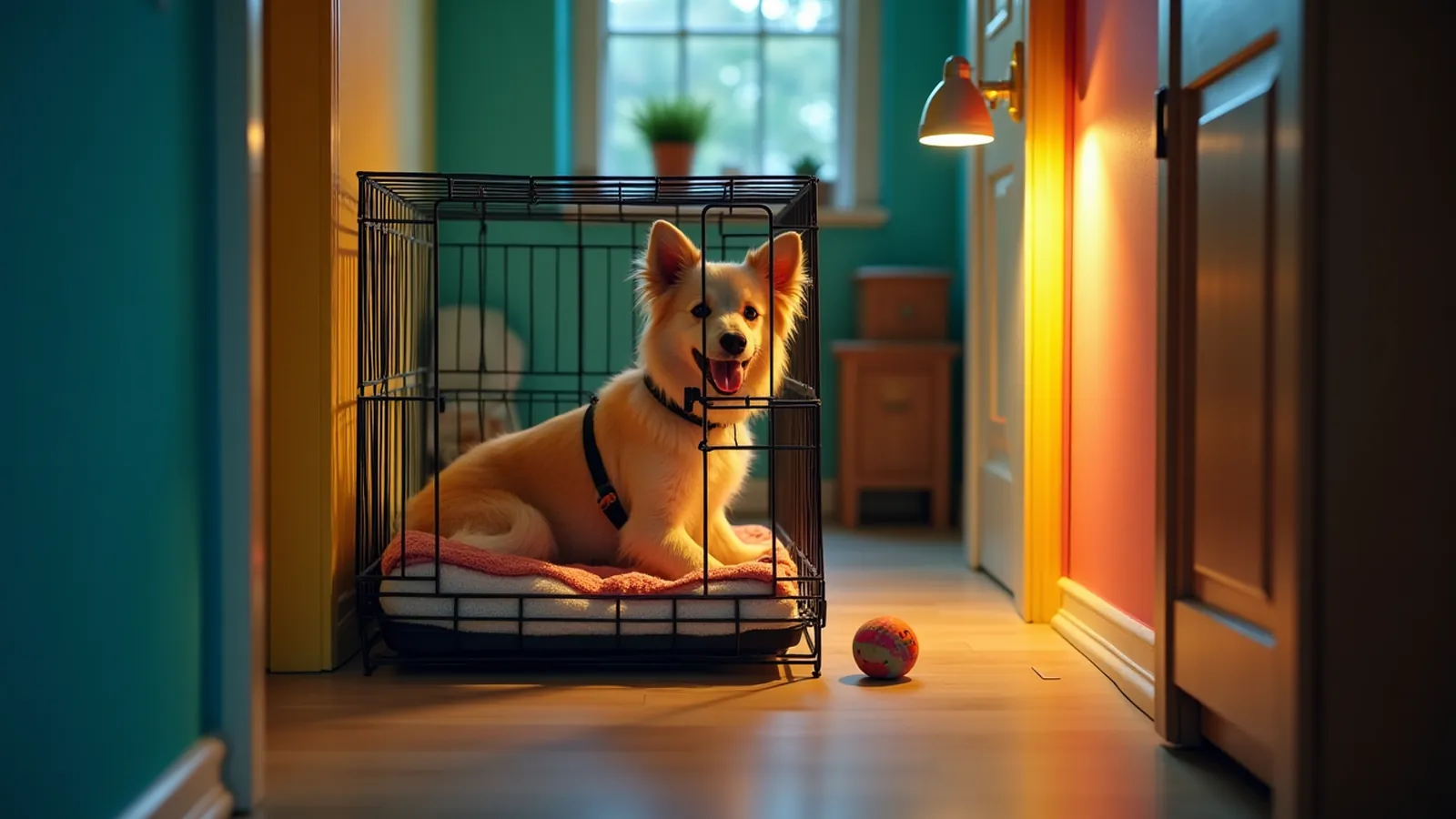
Crying at 2 a.m. is not proof that you have failed at crate training. Puppies wake, they need to toilet, and a puppy in a new house is sleeping in a strange room with a door between them and you. What you do in those minutes matters more than whether they happen.
- Keep the crate near your bed at first. You hear the difference between a settling shuffle and real distress, and your puppy is not alone in a dark room.
- Go boring. Low light, no chatting, no play, no food beyond the calm toilet trip. If 2 a.m. becomes the most interesting part of the day, it will keep happening.
- Toilet trip, then straight back in. Out to the usual spot, wait quietly, then back to the crate. Reward the outdoor toilet, not the crying.
- If crying starts the second the door closes, that is a crate-comfort problem, not a toilet problem. Go back a step in the daytime: feed meals in the crate, close the door for seconds, open it before any noise starts.
- If the crying is frantic and comes with panting, drooling, clawing or attempts to escape, let your puppy out and stop for the night. That is distress, and it needs help rather than a longer wait.
The full night routine, including how many toilet trips to expect at each age, is in puppy crying in the crate at night. And a puppy who loses sleep tends to bite harder the next afternoon, so a better night usually improves the day as well.
House-training accidents on the rug, and rescue regression when a puppy arrives
The rug accident is almost always a scheduling gap
A puppy who toilets on the rug has usually had access to the rug and no one watching. Puppies need frequent trips out, and a puppy who is loose in the house is a puppy practicing whatever happens next. Shrink the space, take your puppy out more often than feels reasonable, reward every outdoor toilet, and clean thoroughly so the same spot does not keep drawing them back. An accident is data about your routine, not a statement about your puppy's intelligence.
When the rescue regresses
An adult dog who was reliable indoors can start having accidents when a puppy arrives. The household routine changed, the dog's resting places are not theirs anymore, and the attention has moved. That is not betrayal and it is not a relapse you caused by adopting again. Go back to basics for the older dog too: scheduled trips, supervision, reward outside, and a quiet area where the puppy cannot interrupt them. Best Friends notes that a friendly, well-socialized resident dog can be a valuable role model, including for where to go to the bathroom, so give your rescue the calm, predictable day that lets them show the puppy how the house works.
If an adult dog who has been dry for a long time starts urinating indoors suddenly, or seems uncomfortable, book a veterinarian visit before you change the training plan. The step-by-step version for an adult dog, with a schedule, is in how to house train an older dog.
A daily checklist for raising a puppy without the fear
The aim is not to do everything. It is to keep the important things present. This is a floor, not a ceiling: a day that covers two lines is a normal day.
Safety first
Supervise, gate or crate so your dog cannot rehearse the thing you are trying to prevent. Management is not cheating. It buys time for training to work.
One humane repetition
One behavior, one small step, a few rewards. Stop while it is still easy. If your dog will not take treats, that is information about the environment, not defiance.
One calm exposure or enrichment activity
If your veterinarian says it is safe, one new surface, sound, person or quiet outing at a distance your dog can handle. If not, enrichment at home counts.
One repair, then rest
If something went sideways, write down what happened and one smaller version to try next time. Then stop for the day. A repair note beats a guilt session.
For the socialization line, the puppy socialization checklist turns "do everything" into a short, realistic list. Puppy raising works as a rhythm of small repeatable steps, not a sprint you are already behind on.
Raising a puppy and a rescue dog in the same house
Two dogs at different stages makes every decision feel double. The rescue may still be settling in while the puppy is learning everything for the first time. Best Friends notes that a friendly, well-socialized dog already in the household can be a valuable role model for everything from how to play to where to go to the bathroom. That is a reason to let your resident dog demonstrate calm behavior, not a reason to use the rescue as a training tool.
Train one dog at a time. Use a gate, a crate or a closed door so the other dog is not rehearsing the behavior you are changing. Walk them separately if the sight of the other dog makes either one pull, and let the rescue walk away from puppy play whenever they want to. If your rescue growls, snaps or guards something, that is a signal rather than dominance, and it is not something to correct. Separate the dogs calmly, then get professional help.
A puppy starts barking at the rescue over a toy. Nobody gets corrected. A gate goes up between them, the puppy gets a chew in the crate, and the rescue keeps the toy and the sofa. Later, when both are calm, there is one short sit session with the puppy in the kitchen and one short hand-target session with the rescue in the hallway, one dog at a time. The rescue's dinner goes down in a quiet room where the puppy cannot hover. That evening counts as training, even though it looked mostly like tidying up.
If you have already tried YouTube and a puppy class
You are right to be skeptical of anything promising a quick fix. A video can show you a technique. A group class gives you supervised practice in one room, with no second dog, no doorbell and no history you cannot see. Neither automatically gives you a plan for a household running a puppy and a rescue at different stages, which is exactly the gap that leaves people buying course after course.
That does not mean the next program is the answer. It means you need a better filter. Before spending money, check four things: whether it uses reward-based methods throughout; whether it explains what to do when a step fails; whether it covers fear and alone-time distress honestly instead of promising to end them; and whether it tells you when to see a veterinarian or a qualified behavior professional. If a sales page promises a trained dog in a set number of days, close the tab.
If you are weighing The Online Dog Trainer (opens in a new tab), our Doggy Dan review describes only what the vendor's own pages state, dated, and names the free alternatives that may be enough. We have no affiliate relationship with The Online Dog Trainer today, and we earn nothing if you buy. If that changes, this sentence and the links will say so. The same questions, applied to any course, are in online puppy training courses.
Gear deserves the same filter. If the last front-clip harness did not stop the pulling, that is not proof you failed: a harness is a management tool, and it does not teach a dog what to do instead of pulling. Start with what to look for and how to check fit in choosing a no-pull harness, and expect the first sessions to be about wearing it calmly, before it does any work on a walk.
When you freeze mid-training: a three-question reset
It takes under a minute, and it works for puppy raising and rescue training alike.
- If the question is "Is this safe?"
- Manage first. Separate the dogs, add distance, put the leash on, end the greeting. A safety decision does not need to be elegant. It needs to be now.
- If the question is "Is this the right method?"
- Choose the reward-based version: reward what you want, prevent what you do not want, make the step smaller. If you are still unsure, stop the session and check a cited guide rather than pushing through.
- If the question is "Did that just ruin everything?"
- Ask what the dog actually learned in that moment. One messy repetition is not a curriculum. Reset the environment, lower the difficulty, get one clean repetition, and stop.
Tip
Keep a "next small step" note on your phone: stand two steps farther back, reward the sit before the jump, stop after one good repetition. When you freeze, you read the line instead of inventing a plan under pressure.
When to get professional help
Stop and call for help if
- A bite breaks skin or leaves a bruise.
- Your dog guards food, toys or a person with a growl, snap or bite.
- Your dog shows severe or panicked fear and does not recover after a scare.
- Your dog injures themselves trying to get out when left alone, or panics every time you leave.
- Your dog's behavior changes suddenly, especially if they seem painful, disoriented or unlike themselves.
Who to call. Start with your veterinarian: pain, illness and medication side effects can all show up as behavior changes. For behavior problems, look for a board-certified veterinary behaviorist (ACVB directory), a certified applied animal behaviorist, or a certified behavior consultant, for example through the IAABC or the CCPDT directories. Ask any trainer which methods they use; reward-based is what the American Veterinary Society of Animal Behavior recommends.
Good Dog Basics is an education site, not a veterinary or behavior practice. When a problem is sudden, painful or severe, the right move is a referral rather than another video.
If the main issue is being left alone, a crate and someone checking in are not a plan. The review cited below describes separation-related problems as a cluster of behaviors that can involve fear, frustration and panic, notes estimates of between 22.3 and 55 percent of the general dog population, and says there is no single diagnostic test. That is exactly why an individual assessment matters.
Frequently asked questions
Am I ruining my puppy if I miss a day of training?
No. A missed day is a gap in practice, not a change in temperament. Pick one small skill, do a few easy repetitions, and restart. The high-stakes areas are safety, humane methods, positive exposure and getting help for fear or panic. A training log is not one of them.
What matters most when raising a puppy?
Keep the dog safe, use reward-based methods, and offer positive exposure the dog can opt out of. Best Friends describes socialization as comfort with people, dogs, objects and everyday events, and says the way it is done matters. A short calm experience beats a crowded forced one, and puppy raising is a rhythm of small repeatable steps.
Is raising a puppy dog different from raising an adult rescue?
The principles are the same, the starting points are not. A puppy is new to everything. A rescue may bring habits and fears you did not see, and Best Friends notes that plans for rescued dogs have to be tailored to the individual. Same checklist, different time on each line, slower pace for the dog still deciding whether people are safe.
Is it too late to start puppy raising at five or six months?
No. Early learning matters and later learning still matters. If your puppy is past the youngest weeks, start with safety, routine and one small skill, and use short sessions your dog can succeed at. If fear or aggression is involved, get professional help rather than pushing through a home program.
Should I take my puppy out before vaccinations are finished?
Ask your veterinarian. The answer depends on your area, your puppy's schedule and the places you choose. AVSAB's position statement on puppy socialization advises early, safe socialization with veterinary guidance, which means your vet weighs the benefit against local disease risk. Never skip or delay veterinary advice.
Can one scary experience ruin my puppy?
One bad moment is not a life sentence, but it is worth repairing rather than ignoring. Go back to a distance or intensity where your dog can cope, pair the thing with food, keep sessions short, and let the dog leave. If your dog stays panicked, freezes or reacts for days afterward, contact your veterinarian and a qualified behavior professional.
Sources
- Position Statement on Humane Dog Training, American Veterinary Society of Animal Behavior (accessed October 29, 2026).
- Position Statement on Puppy Socialization, American Veterinary Society of Animal Behavior (accessed October 29, 2026).
- What to Expect When Rescuing a Puppy Mill Dog, Best Friends Animal Society (accessed October 29, 2026).
- Separation related problems in dogs, PubMed Central (accessed October 29, 2026).
New puppy? Start here
The first weeks in the order that matters: sleep, toilet trips, the crate, biting and safe socialization.