
Adult Dog Manners
Dog barking at the doorbell: a calm door plan that gives your dog a job
The ring is a prediction, and right now it predicts chaos. This plan makes it predict food and a mat, with a gate so you can answer the door before the training is finished.

On this page (11 sections)
- Why the doorbell sets off a frenzy
- Start with management, before any training
- How to stop dog barking at the doorbell: the step-by-step plan
- The door protocol for real visitors
- Two dogs, one door: keeping the plans separate
- Gear, programs, and the honest version of "will this work"
- Troubleshooting
- When to get professional help
- Frequently asked questions
- Keep going
- Sources
The doorbell rings and the hallway detonates: one dog barking at full volume, the other joining in, both skidding toward the door while you try to sign for a package, hold a collar and apologize to a delivery driver at the same time. Answering your own front door should not feel like a test you fail every afternoon.
Dog barking at the doorbell is one of the most workable problems in the house, because the trigger is a sound you control. You can make it quieter, repeat it ten times in a row, and decide what happens after it. This plan starts with management so your dog stops rehearsing the frenzy, pairs the bell with food at a volume he can handle, then teaches a send-to-mat so the ring predicts a job instead of an alarm.
Key takeaways
- The bell is a prediction, not a command. Change what it predicts: sound, then food, then the mat.
- Stop the rehearsals first, with a gate and a text-first plan for guests.
- Practice the sound quieter than the real thing, and deliver food after the bell, never before it.
- Give the bell a job: a send-to-mat built in seconds, with a release word that always ends the settle.
- In a two-dog house, train one dog at a time, or the second dog is being paid by the first one's noise.
- Growling, snapping, panic at the door or a sudden change in an adult dog goes to your vet first, then a qualified behavior professional.
Why the doorbell sets off a frenzy
The bell is rarely the whole problem. It is a prediction: in your dog's experience that sound is followed by footsteps, a shape at the glass, you moving fast, a stranger's voice and sometimes a person walking in. For a rescue still deciding whether strangers are safe, or a puppy meeting his first delivery driver, that is a lot to absorb at once.
It also works, which is the part that keeps it going. The barking gets movement, attention (even the frustrated kind), the door opening and a person appearing. From your dog's side of the hallway, the noise is doing its job.
The barking is an emotional response to a prediction, not a decision to ignore you. Work on dogs left alone makes a related point: what looks like one behavior from the outside can sit on several different emotional processes at once, including fear, frustration and panic (the review authors describe this for separation-related problems, and it is a useful caution at the door too). That is why a plan that only asks for quiet tends to stall.
In a two-dog house there is a second engine: barking is contagious. One dog's alarm raises the other's arousal, and the second dog is being paid by the first dog's noise. Door barking is also not dominance, not a dog guarding the house from you, and not something a correction settles. Good Dog Basics follows the AVSAB Position Statement on Humane Dog Training: reward what you want, manage the environment so the dog cannot rehearse what you do not want, and change the picture in small steps.
What not to add
Shouting, a spray bottle, a shaken can of coins, a leash pop, a hand over the muzzle and an alpha roll all add arousal and attention to a dog who is already loud. This site does not use or recommend shock collars, e-collars, prong or choke collars, or "pack leader" corrections, at the door or anywhere else. None of them change what the bell predicts, which is the actual job.
Start with management, before any training
Management is not a workaround. Every full-volume rehearsal at the door makes the habit a little more automatic, so these five setups are how you stop feeding the old pattern while you build the new one. Set them up today, before the next delivery.
- Gate the hallway. A baby gate or a closed door between your dog and the front door lets a delivery happen without a dog at the glass.
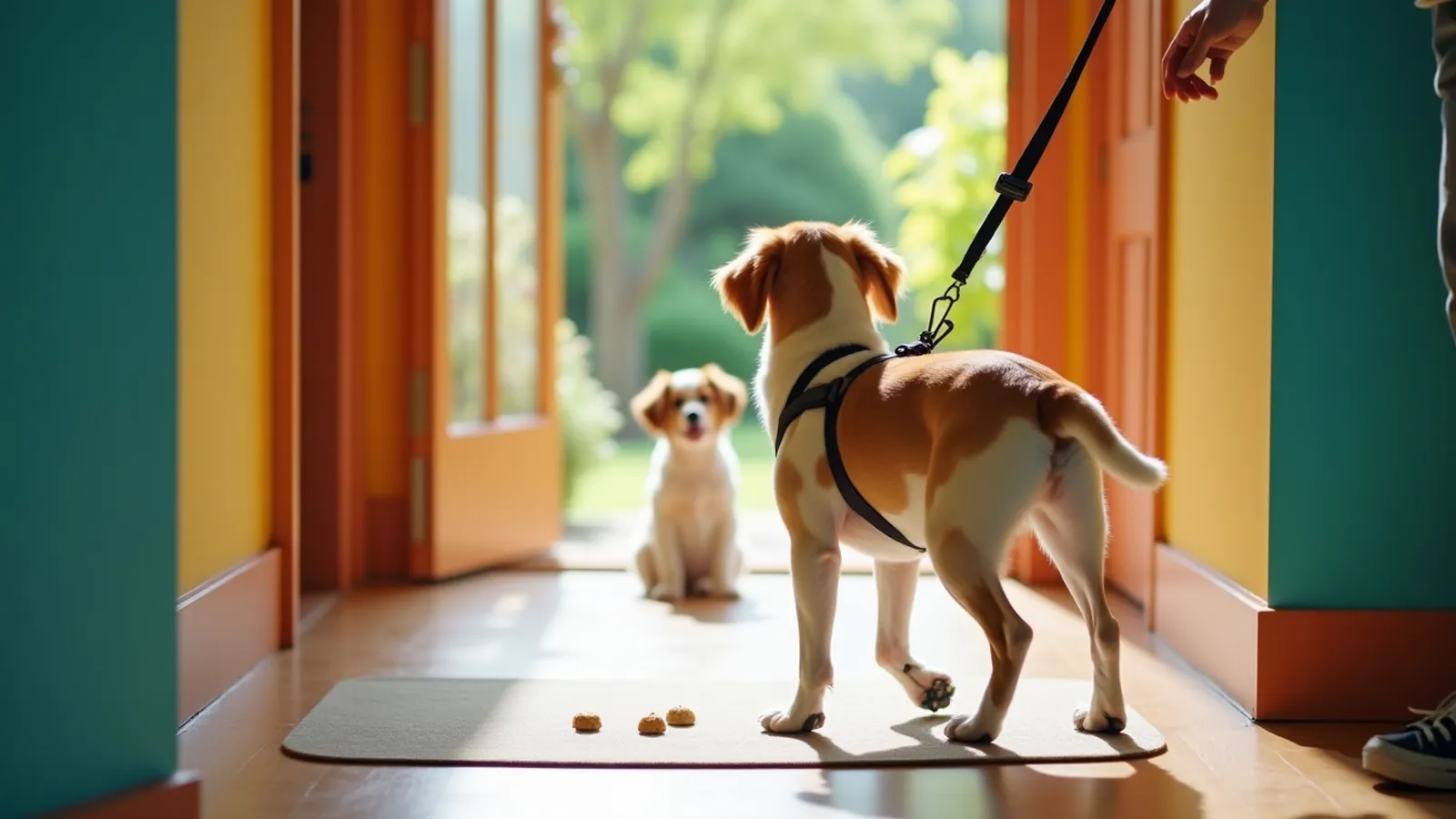
- Put the mat down before you need it. Choose a bed a few paces back from the door, out of the walking path. This is where your dog will eventually go when the bell rings.
- Keep food at the door. A small jar of kibble within reach means you can pay a quiet dog without a trip to the kitchen.
- Run a text-first guest plan. Ask friends to text on arrival and wait rather than knocking, so you can set the gate and the mat, then open the door on your terms.
- Take the pressure off deliveries. A knock-and-leave note or a box outside removes the hardest version of the event while you train.
None of it is permanent. It buys the quiet repetitions that make training possible, so one bad delivery does not undo a week of work.
How to stop dog barking at the doorbell: the step-by-step plan
Two jobs run side by side: change what the sound predicts (bell, then food), and give your dog somewhere to go (the mat). Practice in short sessions a few times a week. Order matters more than speed, and every dog moves at a different pace.
Make the sound small
Record your doorbell on your phone, or find a recording that sounds like it, and play it at the lowest volume the phone allows, quieter than the real bell. If your doorbell has a volume setting, turn that down too. If your dog barks, the volume went up too fast or he is too close to the door.
Pair the sound with food, in that order
Play the sound once, wait a beat, then deliver food: dropped on the mat, scattered on the floor, or fed by hand. Sound first, food second, every time. If the food appears first, your dog is learning that food predicts the bell. Say nothing during the rep — no "quiet", no "it's okay", no treat held out to lure him to the mat.
Watch the response, then move one notch
After a handful of repetitions, look for the pairing landing: the bell plays and your dog turns toward you or the mat before the food arrives. Softer ears, an unhurried walk and a loose body are good signs. Then raise the volume one step, or move one step closer to the door. If he barks, go back a step and stay there for a few more sessions.
Add realism one ingredient at a time
Phone recording at low volume, then the real bell at low volume, then the real bell at normal volume with you in another room, then a knock on a door, then a knock at the front door. Change one thing per session — volume, distance or your position — never all three. It is the same principle as the plan for jumping up at greetings: each step small enough to be paid.
Teach a send-to-mat
Now give the bell a job. Pay the mat generously with no bell at all: drop treats on it as you walk past, feed a few meals there, reward standing, sitting and lying down. When your dog starts choosing the mat on his own, say "mat" as he steps on and pay. Then play the bell, and as he turns toward the mat, say "mat" once and pay when he arrives. Build the hold in seconds, rewarding while he is still lying down, and add a release word such as "free" that always ends the settle.
Add the door itself, an inch at a time
With the gate between you and your dog, practice these separately: hand on the knob, latch turning, door opening an inch, door wide open with nobody there. Pay from the mat after each one, and only add a real person once your dog can hold the mat with the door open. The gate stays up, so a mistake cannot become a door rush.
Run one staged guest
Ask one patient friend to text on arrival, wait outside and follow your instructions. Dog on the mat behind the gate, bell or knock, food for staying, then the door opens and the guest ignores the dog completely for the first minute. If your dog breaks the settle, the guest waits outside while you reset. That is not failure; the rehearsal was too big.
Repeat in real life, with the gate as your safety net
Real deliveries will still happen. Use the gate, pay the quiet you get, and put a mat session in later that day. Keep sessions short and end on the best repetition, not the worst. Progress is measured by how quickly your dog recovers and where he chooses to go, not by a number of days.
The door protocol for real visitors
Write this down once and use it every time, so the humans stay consistent while the training is still thin.
| Moment | What you do | What your dog gets |
|---|---|---|
| Before the visit | Text-first arrival, gate up, mat set, food in your pocket | A predictable spot and no chance to rehearse the rush |
| The bell or knock | One sound, then food on the mat | A bell that predicts food, not a stranger |
| The door opens | Guest steps in and ignores the dog for the first minute while you pay the settle | A boring, calm greeting instead of a wind-up |
| A few minutes in | Release from the mat if he is relaxed, or keep the gate up if he is not | A choice that matches his actual state that day |
Two dogs, one door: keeping the plans separate
A puppy and a rescue at different stages cannot run the same session at once. One dog's barking pulls the other over his limit, and a dog watching from behind a gate is still learning something — often that the door is the most exciting thing in the house. Train the dog who is further along while the other is in another room with a chew, then swap on another day. If both must be present, use two mats with a barrier and never pay the second dog for joining a chorus.
A household has a young puppy and an adult rescue. The puppy does doorbell practice in the kitchen with the gate up and the phone speaker under a cushion. The rescue works in the hallway, further from the door, while the puppy naps. When a real parcel arrives, both dogs go behind the gate and neither is asked to hold a mat. After a few weeks of separate sessions, the rescue turns toward his mat when the bell plays on the phone.
If your rescue is new to your home, keep everything smaller for longer. Best Friends, writing about dogs from puppy mills, advises keeping each step short enough that the dog shows no signs of anxiety — pacing, pawing at a barrier, digging, crying or barking — and building up very gradually over the next few weeks, using positive training only and no punishment. The 3-3-3 rule for rescue dogs explains why a dog who is still settling in may not be ready for a doorbell plan in his first weeks.
Gear, programs, and the honest version of "will this work"
If you have already worked through free videos and a puppy class and your rescue still launches at the door, the skepticism is earned. Generic advice usually fails for one reason: it skips the two parts that make it work in your house, which are management that stops the rehearsal and a step small enough for your dog today.
On gear: a gate helps you hold a dog safely at the door, and a front-clip harness can make a big dog easier to hold on a walk, but neither one changes the emotion behind the barking. Research on how harnesses affect a dog's movement is still limited — one study that measured joint motion in four dogs wearing different harnesses said its sample was too small to draw conclusions about individual harnesses. So nobody, including this site, can tell you a particular harness will change a behavior. What you can do is check fit and comfort and pair it with training; the harness training plan for a wary rescue walks through that.
On programs: no course, free or paid, can promise an outcome, and any page that promises to end the barking in a set number of days is telling you about its marketing rather than about dogs. Fair things to check before you spend: does it name your exact problem, does it change the environment as well as the cue, does it train one dog at a time, and does it use reward-based methods only. We have no affiliate relationship with The Online Dog Trainer today, and we earn nothing if you buy. If that changes, this sentence and the links will say so. If you would rather watch a door routine demonstrated than read it described, The Online Dog Trainer (opens in a new tab) is the program this site points to; its own sales pages, as listed on its site on October 27, 2026, are summarized in the Doggy Dan review, along with the free routes to the same skills. This doorbell plan needs a gate, a mat and some food, nothing else.
Troubleshooting
- If your dog barks at the recording even at the lowest volume
- Go quieter still: put the phone under a cushion or in another room, or start with a soft knock instead. Pay any pause, even half a second of quiet, and stay at that level for several sessions.
- If practice is calm but the real door still sets him off
- Your practice is too far from the real picture. Move sessions into the hallway, add your coat and keys, and let the gate take the hit while you build up.
- If he goes to the mat and barks from there
- Pay the quiet on the mat more often, and do not open the door while he is barking. Wait for a gap, even a small one, and pay that.
- If the second dog sets off the first
- Separate them for training blocks, one behind a closed door with a chew. Do not pay the dog who joined in, and keep sessions short enough that neither dog winds up.
- If your puppy is fine but your rescue panics or freezes
- Stop the session, go back to a step he accepted easily, keep your voice low and your movements small, and give it a few days. If he flattens or tries to hide, the step was too big.
When to get professional help
Stop and call for help if
- Your dog growls, snaps, freezes or bites at the door, or lunges at a guest as they come in.
- Door barking started suddenly in an adult dog, or comes with pacing, panting, drooling, appetite or sleep changes. Start with your veterinarian.
- Your dog panics at the sound itself — trembling, hiding, trying to escape — rather than barking.
- Two dogs in the house are escalating at the door together and one is getting hurt or cornered.
- Your rescue seems fearful of you or of the house in general, not just the door.
Who to call. Start with your veterinarian: pain, illness and medication side effects can all show up as behavior changes. For behavior problems, look for a board-certified veterinary behaviorist (ACVB directory), a certified applied animal behaviorist, or a certified behavior consultant, for example through the IAABC or the CCPDT directories. Ask any trainer which methods they use; reward-based is what the American Veterinary Society of Animal Behavior recommends.
None of that means you have failed, and none of it means either dog is ruined. It means the problem has moved past manners into behavior and safety, and the next step is a vet and a qualified behavior professional rather than another video. Pages here are written with AI-assisted drafting and checked against the sources at the bottom; how we write explains the process and its limits.
Frequently asked questions
How do I train my dog not to bark at the doorbell?
Two things at once. Use a gate so real visitors stop giving your dog full-volume rehearsals, and run short sessions where you play the bell quieter than the real thing and deliver food right after it. Then teach a send-to-mat so the sound predicts a place to go. Order matters: sound first, food second, every repetition.
Will feeding treats at the doorbell just teach my dog to bark for treats?
Not if the order stays right. The sound comes first and the food always follows it, so the bell predicts food. If your dog starts offering barks to make the bell play, stop that rep, go back to paying quiet and mat choices, and keep the food out of sight until the sound has happened.
Should I open the door while my dog is barking?
Not while you are training, because the door opening is the biggest payment the barking can get. Use the gate for real deliveries so you never have to choose between answering the door and holding a dog. In practice, wait for a gap of quiet and pay that before the door moves.
Do I need to buy anything for this?
A gate of some kind and a mat are the useful items, and both can be secondhand. A doorbell you can turn down, or a phone recording, is the other piece. Nothing you buy will change what the sound predicts; the repetitions do that, which is why this plan works without a course or a gadget.
Sources
- Position Statement on Humane Dog Training, American Veterinary Society of Animal Behavior (accessed October 29, 2026).
- What to Expect When Rescuing a Puppy Mill Dog, Best Friends Animal Society (accessed October 29, 2026).
- Issues With Separation Related Problems in Dogs, PubMed Central (accessed October 29, 2026).
- Effect of harnesses on joint motion in dogs, PubMed Central (accessed October 29, 2026).
Door manners are one piece of the everyday set
Jumping up, leash pulling, recall and door barking, one clear plan at a time, with rewards and no aversive gear.