
Rescue Dog
Dog scared of vacuum: a step-by-step sound plan that also covers the doorbell and the trash truck
Pair each scary sound with food he loves, at a volume and distance where he can still eat and think, then raise one thing at a time. The vacuum, the trash truck and the doorbell get separate short sessions.
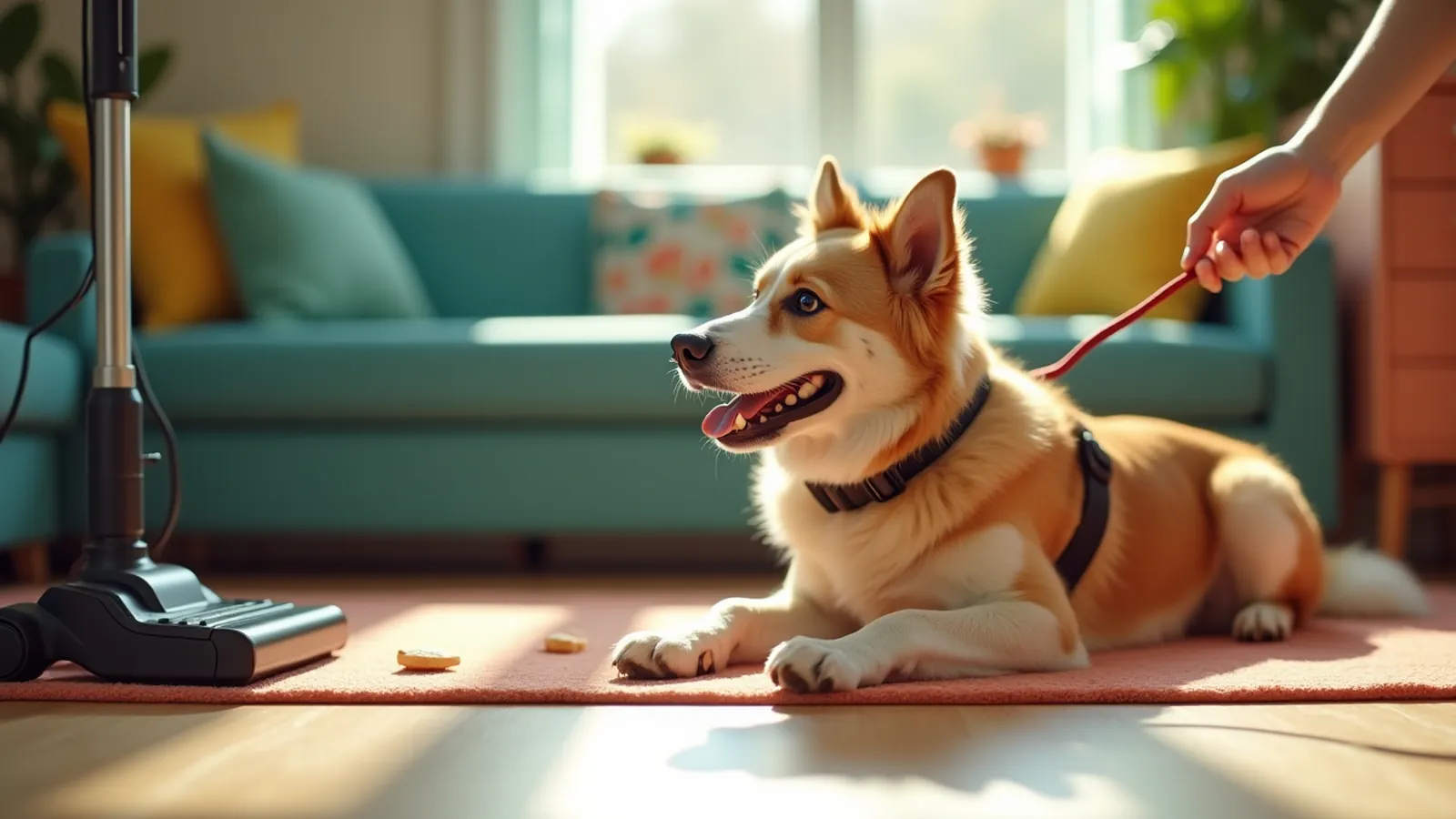
On this page (12 sections)
- Why a dog scared of the vacuum hides under the bed
- The counterconditioning plan: five steps
- Build a ladder for each sound
- Using a doorbell recording instead of the real bell
- Two dogs at different stages
- When the sound is happening right now
- “I have tried videos and a class — why would this be different?”
- Troubleshooting
- When to get professional help
- Frequently asked questions
- Keep going
- Sources
A dog scared of the vacuum will bolt the moment it starts — and if your rescue dog is new, the sound can send him under the bed for hours. The doorbell and the trash truck do the same, so you clean in a rush while he is out on a walk and wonder whether he will ever stop hiding.
It is hard to watch, and it does not mean you have ruined him. The plan is counterconditioning: pair each scary sound with food he loves, at a volume and distance where he can still eat and think, then raise one thing at a time. The vacuum, trash truck and doorbell get separate short sessions. Nobody can promise a date; every dog is different. If he also panics when you leave, start with dog separation anxiety training. If he is still in his first weeks home, the Rescue Dog guide puts noise work in order.
Key takeaways
- The sound predicts food. Sound first, treat second, every time.
- Start at the quietest volume and greatest distance where he still eats and stays loose.
- Raise one thing at a time: volume, distance or duration.
- Vacuum, trash truck and doorbell get separate sessions.
- Manage the noise before you clean, and train one dog at a time.
Things this guide mentions
Amazon searches, not product picks: we have not tested what they show. Check sizing, materials and the return policy on each listing before you order.
Why a dog scared of the vacuum hides under the bed
A dog scared of the vacuum is not being dramatic. A vacuum is loud, sudden, moving and out of his control. He cannot predict when it starts or make it stop, and hiding is coping, not stubbornness.
With a rescue, you may never know what came before. Best Friends says trust builds in small increments and that a consistent schedule is a critical part of it, and it advises a soft, soothing tone of voice so you don't startle or worry a noise-sensitive dog. This plan removes the surprise, then adds the sound back in doses he can handle. Do not run the vacuum beside him until he gives up, and do not pull him out from under the bed.
A frightened dog is not learning the lesson you think you are teaching. If he is shut down, trembling or refusing food, he is not forming a happy association with the noise; he is getting through it. The useful work happens just below that point, where he notices the sound and can still take food.
The counterconditioning plan: five steps
Set up one short session per sound. A session is a handful of repetitions, not a whole vacuuming, and you stop while it is still easy. A few good repetitions beat a long session of a dog holding his breath.
Pick one sound and make it controllable
Record your vacuum, your doorbell or the trash truck from a distance. A recording has a volume knob; the real thing does not. For the trash truck, use distance instead: window closed, dog in the far room. Save the real vacuum for later rungs.
Move on when: you have a recording you can play at the lowest volume.
Find the quietest volume he notices and stays calm
Play it once at the lowest volume that gets an ear flick, then feed a piece of something good. If he looks and comes back for food, you are at the right level. If he freezes, stops eating, leaves or drops the treat, go quieter or further away and try once more. The right starting point is boring: he notices, he eats, he carries on.
Stay here until he eats easily, then repeat the level once before changing anything.
Sound first, then the treat
The order is the method. The sound comes on, then food arrives. That is how the noise becomes a predictor of something good. Do not wave the treat first to coax him through the noise, and do not feed only after he has been brave for a long time.
Timing: food arrives right after the sound starts, while it is still playing, so the noise predicts food rather than relief.
Raise one thing at a time
Volume, distance or duration — one per session. One notch louder at the same distance, or the same volume from one room further away. Change two things and you will not know which one was too much when he hides. If you are unsure, repeat the last easy step; repeating is not wasted time.
Move on when: he finishes still eating and still able to lie down or sniff.
End while it is still easy
Stop after a good repetition, not a bad one. Put the sound away and do something ordinary. Do not finish by running the real vacuum beside him to see whether it worked: a test is a session you did not plan, and it can undo several good ones.
Then: repeat the same level next time before you climb another rung.
The treat test
Food is your volume gauge. A dog who is still eating can still learn. A dog who stops eating, turns away, pants, trembles or tries to leave is over his limit. End the session and go back a rung next time.
A household with a rescue dog and a puppy starts with the vacuum recording only. Session one: the phone plays at the lowest volume in the kitchen while the rescue dog is in the living room, and a piece of chicken lands on his bed. He eats it and looks at the phone. Session two repeats the same thing. Session three moves the phone to the doorway. The puppy spends all three sessions behind a gate in the hallway with a chew, because one dog trains at a time. Nobody runs the real vacuum near the rescue dog until he is eating calmly with the recording at the doorway.
Build a ladder for each sound
Think of each sound as a ladder. The bottom rung is the quietest, furthest version; the top rung is the real thing on a normal day. Climb one rung at a time, and stay on a rung as long as it takes.
| Sound | Bottom rung | One rung up | Top rung |
|---|---|---|---|
| Vacuum | Recording at the lowest volume, dog in another room with the door open | Recording louder, or real vacuum in the next room while he eats | Real vacuum in the same room while he works on a chew |
| Trash truck | Recording at low volume, or the real truck through a closed window from the far end of the house | Window open, truck outside, you feeding treats at a distance | Truck at the curb while he is outside on a harness and leash, eating |
| Doorbell | Recording of your own bell at the lowest volume | The same recording louder, with you standing up as it plays | A helper rings the real bell while you scatter treats on the floor |
Never skip a rung because a session went well: repeat it once, then climb. If a session goes badly, take one rung down and stay there for a couple of sessions. Keep the three ladders separate — each sound has its own history, its own volume and its own food value, so a good vacuum session does not mean he is ready for a louder doorbell.
Using a doorbell recording instead of the real bell
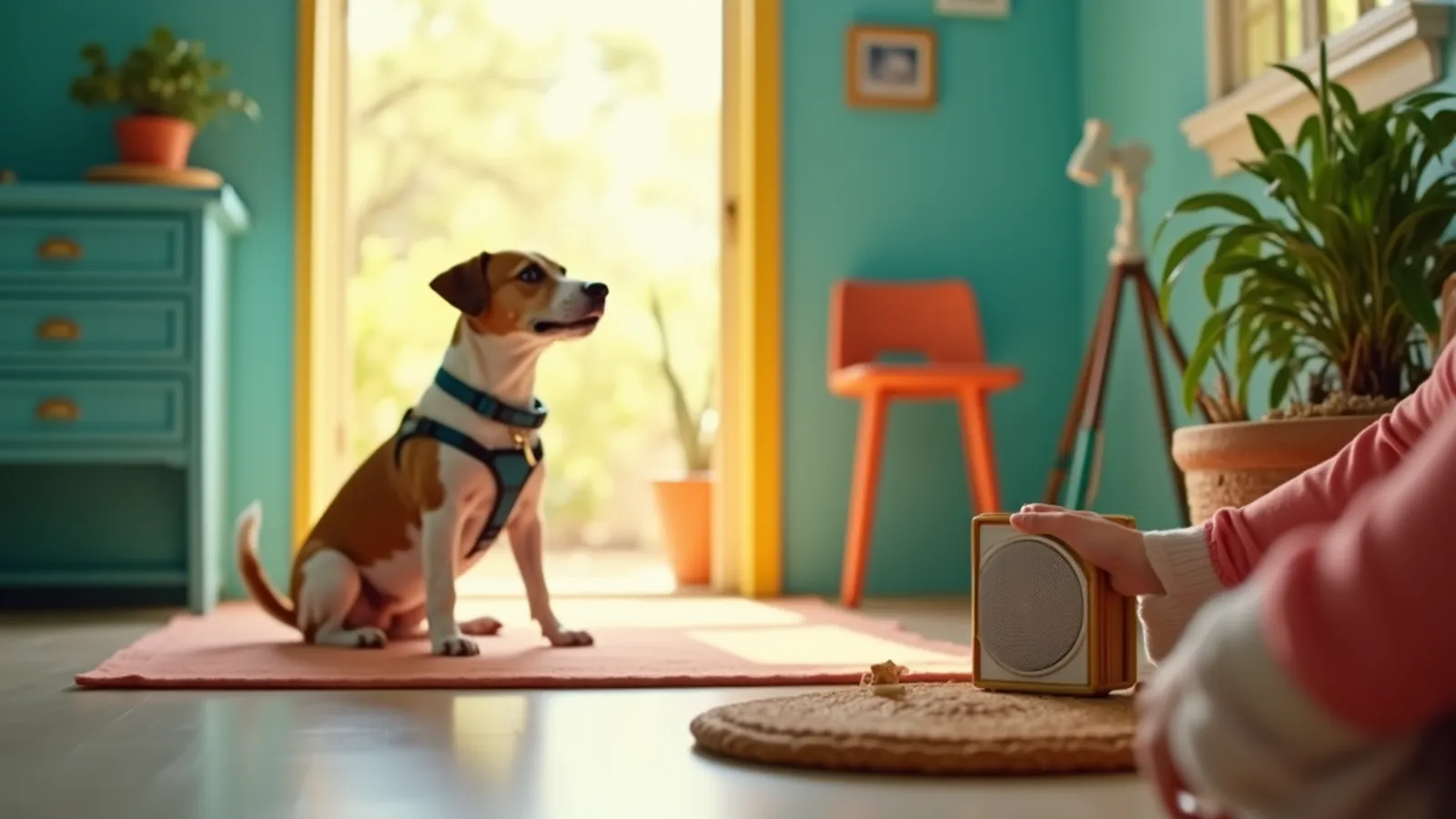
You can find doorbell clips online, but the hard part is using one at a level your dog can handle — recording your own bell solves that. A recording lets you start at a whisper and climb in steps you control, which the real bell cannot.
- Match the tone. Record your own bell on your phone from the hallway. If you use a clip, pick the same kind of chime so the learning carries to your front door.
- Recorded first, real bell second. Get him eating calmly with the recording at low volume, then louder, then have a helper ring the real bell while you scatter treats.
- Scatter food on the floor. Food on the floor gives him something to do with his nose and stops him staring at the door.
- Keep it in its own session. Do not stack doorbell work on vacuum practice, or right after the trash truck has rattled him.
The doorbell is tricky to practice because it predicts a person. That is why the food has to come before the door opens, not after. If he also barks and rushes the door, the sound work is half the job; the arrival routine is in dog barking at doorbell: a calm door plan.
Two dogs at different stages
The puppy does not need to watch, and the rescue does not need an audience. Run every session with one dog, and put the other somewhere pleasant with a chew and a closed door or gate. A puppy bouncing at the vacuum adds a fast-moving dog to a scary noise, which is not the lesson either dog needs.
Best Friends makes a related point about dogs living together: do not let interactions become overexcited, and keep sessions short until both dogs are calm. This is also why a two-dog household feels harder than the advice suggests. You are not running one plan; you are running two, at different levels, with a gate between them.
Make the waiting dog's side of the gate the best part
A food puzzle or long chew gives him something to do while he waits. food puzzles for dogs (Amazon, affiliate link) opens in a new tab are one option. The dog behind the gate is not missing out; he has a quiet job of his own.
When the sound is happening right now
On the day of the noise, management beats training. Training is the planned session; management stops him rehearsing the panic in between.
- Before you vacuum: settle him in a room with a closed door, something soft and a chew, or take him for a sniffy walk while someone else cleans. This buys quiet days until the ladder has climbed a few rungs.
- If he is already under the bed: leave him. Do not reach in, call him out or move the furniture. Turn the noise off and go about your day quietly.
- Trash truck: if you know the day, close the windows, have a chew ready, and plan a lower-rung session later if he is up for it.
- Doorbell: scatter food before you open the door, every time, so a person arriving keeps predicting food on the floor.
- Afterwards: offer something calm — sniffing, licking, chewing, a slow yard walk.
If he is willing to walk with you, a well-fitting harness and leash are worth getting right — see how to choose and check a no-pull harness and harness training for a scared rescue dog. A gait-analysis study describes a method for comparing a dog's movement free, wearing a harness and on a leash, and its authors suggest such reports can help when selecting a harness; it is a way to check fit, not a rule about which harness to buy.
“I have tried videos and a class — why would this be different?”
Because a class cannot follow you home and turn your vacuum down. Noise work happens in your house, at your dog's volume, in repetitions short enough to stop before he hides. A group class is good for sit, down and loose-leash basics; it is not built for the specific sound of your doorbell in your hallway.
This page is not a course, and it is not a veterinarian's or behaviorist's plan. It is a step-by-step plan built from the sources listed below, and you can start today with a phone, food he loves and a door you can close. If you want a structured program instead, We have no affiliate relationship with The Online Dog Trainer today, and we earn nothing if you buy. If that changes, this sentence and the links will say so. You can read what The Online Dog Trainer (opens in a new tab) says on its own pages and compare it with the free steps here. The honest test for any paid program is whether it tells you what to do at each step, what to do when the dog stops eating, and when to send you to a vet or behavior professional.
On gear: a new harness will not change how he feels about the vacuum. If he also pulls on walks, that is a separate plan — see how to stop your dog pulling on the leash — and it is fine to work on one thing at a time.
Troubleshooting
- If he will not take food even at the lowest volume
- Change something else: a different room, more distance, better food, or a day when nothing else has spooked him. Try one repetition and stop.
- If he is fine with the recording but hides from the real vacuum
- The recording misses vibration and low motor hum. Start the real vacuum in another room with the door closed, food first, and cut the session shorter than you think.
- If he hides for hours afterwards
- That session went too far. Drop back a rung, keep the next sessions very short, and mention it to your vet if the hiding is new or lasting longer each time.
- If the doorbell sets off barking
- Go back to the recorded bell at low volume and scatter food before it plays, then use the door plan.
- If he recovers faster but still hides
- That is progress. Track shorter hiding, a faster return and eating sooner — not the calendar.
Once noise work is moving, the same small-steps approach extends to other exciting situations: training with distractions.
When to get professional help
Stop and call for help if
- His fear is severe, panicked, or getting worse instead of slowly better.
- He hides for hours, will not eat, trembles, cannot settle, or injures himself trying to get away from a sound.
- He growls, snaps or bites when you approach him where he is hiding, or when you touch him.
- Any sudden change in behavior, or fear that appears out of nowhere — start with your veterinarian.
- He also panics when left alone: scratching at doors and windows, constant barking, house soiling, or self-injury.
Who to call. Start with your veterinarian: pain, illness and medication side effects can all show up as behavior changes. For behavior problems, look for a board-certified veterinary behaviorist (ACVB directory), a certified applied animal behaviorist, or a certified behavior consultant, for example through the IAABC or the CCPDT directories. Ask any trainer which methods they use; reward-based is what the American Veterinary Society of Animal Behavior recommends.
Problems when a dog is left alone show why assessment matters: researchers note the same outward behaviors can come from fear, frustration or panic, and there is no single test that separates them. That is a job for a veterinarian and a qualified behavior professional.
AVSAB's position statement supports reward-based training and warns that aversive methods can increase fear and avoidance, which is the opposite of what a frightened dog needs. If someone advises you to hold the vacuum near him until he stops reacting, or to use a shock, prong or choke collar to “correct” the fear, that is not a plan this site will give you.
Frequently asked questions
How long does it take to stop a dog being scared of the vacuum?
There is no fixed timeline. Progress is measured in sessions, not weeks: look for him eating sooner, hiding for less time and coming back out faster. Some dogs climb a rung in one session; others need many repeats at the same level. Every dog is different, and a rescue dog with a difficult past may need longer at the bottom rungs.
Should I comfort my dog when he is scared of the vacuum?
Yes, calm quiet company is fine, and you do not need to ignore him. What matters is that you do not force him toward the noise or drag him out of his hiding place. Sit nearby, let him choose whether to come to you, and keep the house quiet until he settles.
Is it better to run the vacuum every day so he gets used to it?
That is overwhelming him with the noise and waiting for him to give up, and it risks making the fear worse. Manage the noise first — a closed door, a chew, a walk while someone else vacuums — then add the sound back in planned steps at a volume where he can still eat.
Where do I find a doorbell sound to practice with?
Record your own doorbell on your phone from the hallway; that is the closest match to what your dog hears. A chime clip with the same tone works as a backup. The clip matters less than the two things you control: the volume, starting at a whisper, and the food that arrives right after the sound.
Will my puppy learn to be scared of the vacuum from my rescue dog?
Dogs do watch each other, so keep the puppy out of the rescue dog's sessions and give him his own easy repetitions with the sound low and food arriving. If the puppy starts showing worry, treat it as its own plan: low volume, short sessions, food every time.
Ready to compare?
The same searches, in one place. Gear helps you manage; the training steps above are what change the habit.
Sources
- What to Expect When Rescuing a Puppy Mill Dog, Best Friends Animal Society (accessed October 29, 2026).
- A novel method for the analysis of the gait of dogs: a proof of concept study, PLOS ONE, PubMed Central (accessed October 29, 2026).
- Separation related problems in dogs: a review, PubMed Central (accessed October 29, 2026).
- Position Statement on Humane Dog Training, American Veterinary Society of Animal Behavior, 2021 (accessed October 29, 2026).
Settling a rescue in
The first days, a routine he can predict, and trust that builds in small steps: the Rescue Dog guide puts it in the right order.