
Adult Dog Manners
Dog training with distractions: the proofing ladder that makes 'sit' work at the front door
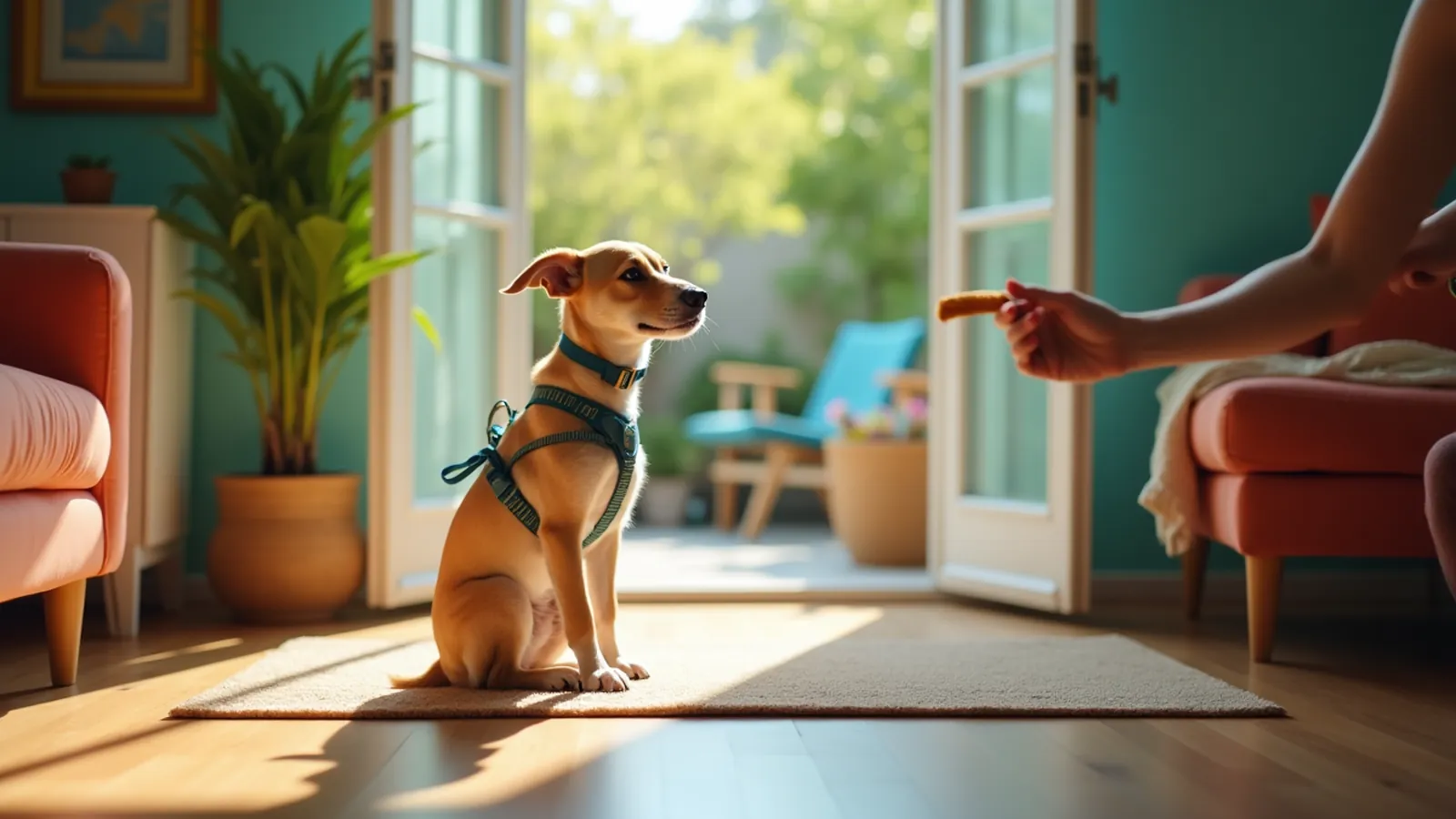
Your dog sits perfectly in the kitchen and forgets every word when the doorbell rings. This plan rebuilds the same cue in the places it has to work, one small step at a time.
On this page (11 sections)
- Why 'sit' works in the living room and disappears at the front door
- How to do dog training with distractions: the six-rung ladder
- An illustrative proofing session: one sit, three rooms, two levels
- Dog training at the doorbell: the sound, the door and the person on the step
- Two dogs at two stages, one plan
- What gear and paid programs will not do for you
- Troubleshooting
- When to get professional help
- Frequently asked questions
- Keep going
- Sources
Your dog sits on the kitchen floor nine times out of ten and lies down before you finish the word. Then a squirrel crosses the top of the fence, or the front door opens, and the dog who knew all of it is simply not in the room. You repeat the cue, then say it louder, and end up holding the leash with both hands while he pulls toward the gap.
That gap is not stubbornness. A cue practiced in one quiet room is a cue practiced in one quiet room. Dog training with distractions is the second half of the job: taking the behavior your dog already has and practicing it in new places, with new movement, new sounds, food on the floor and new people, in steps small enough that he keeps getting it right. This page is that plan, for one dog or two, with a clear rule for when a step needs to get smaller.
Key takeaways
- Reliability in real life is separate work from learning the cue in your living room, and it has steps.
- Climb one rung at a time: distance, movement, sound, food on the floor, another person, then the front door.
- Two misses in a row is information about step size, not a verdict on your dog.
- A doorbell recording you control is easier to train with than the real bell, which arrives whenever it likes.
- Two dogs means two sessions: gate one, train the other, and judge each dog against his own last session.
- Growling, snapping, freezing or panic at the door needs your veterinarian first, then a qualified behavior professional.
Why 'sit' works in the living room and disappears at the front door
Your dog did not learn a cue in general. He learned it in a place, with one person standing one way, at one level of noise, at one distance from the treat jar. Every one of those details quietly became part of what the word means. Change the whole picture at once and the cue has to be built again in the new setting.
So the useful question is not "does my dog know sit?" It is "where, and around what, does my dog know sit?" If he sits in the kitchen with nobody home but not in the hallway while someone puts on shoes, you already know where to start.
The front door is the hardest rung for a great many dogs. In one owner survey of dogs with behavior problems, 574 dogs (75.3 percent) were reported to bark when there was a person at the door, and 582 (76.4 percent) were reported to bark when the doorbell rang. A bell is a short, sharp sound followed by a person arriving, which is close to the most exciting thing that happens in a dog's day.
What not to add when your dog blows you off
Saying the cue louder, a leash pop, a hand on the collar, a shout or a squirt bottle all add pressure to a dog who is already in over his head, and none of them tells him where to put his paws instead. Good Dog Basics follows the AVSAB Position Statement on Humane Dog Training: reward what you want, manage the environment so the old behavior cannot be practiced, and change difficulty in small steps. No shock, prong or choke collars, no leash jerks, no alpha rolls, no "dominance" corrections, here or anywhere else. Dogs Trust, writing about mouthing, nipping and biting, makes the same case in a puppy context: reward the behavior you want and don't punish the behavior you don't.
How to do dog training with distractions: the six-rung ladder
Six kinds of distraction cover most of what happens in a real house and on a real walk. They are listed easiest first, but they are not a strict order. A dog who is relaxed with a stranger ten feet away may still lose his mind over a piece of kibble on the floor. Treat the ladder as a set of dials to turn up and down, and start with whichever dial is already lowest.
| Rung | What it looks like | How to make it smaller |
|---|---|---|
| 1. Distance | The squirrel at the far end of the park, the other dog across the street, the visitor at the end of the path | More space, a barrier, or the trigger out of sight around a corner |
| 2. Movement | You standing still, then stepping sideways, then walking; a jogger; a ball rolling past | Slow the movement, shrink it, or do it further away. Start with your own body before borrowing someone else's. |
| 3. Sound | A spoon in the sink, a knock on the wall, a bell recording at low volume, the mail slot | Lower the volume, muffle it behind a closed door, or play it from another room |
| 4. Food on the floor | A piece of kibble under the table, a scatter of dinner, a chew two feet away | Put the food further off, use less of it, or place it before your dog comes into the room |
| 5. Another person | A family member first, then a friend, then a neighbor, then someone your dog has never met | Fewer people, further away, standing still, with no eye contact and no reaching |
| 6. The front door | Hand on the handle, the door opening, a person on the step, a real delivery | Door closed, then handle only, then an inch, then a person your dog knows before a stranger |
The working rule for this page: change one thing per rep. That is a rule of thumb for step size, not a research finding; the aim is simply to keep the next rep winnable. If your dog misses twice in a row, the step was too big: go back to the version he did well, run three easy reps there, then try a smaller version of the step that failed. Three clean reps in a row is your signal to nudge the dial up.
Pay the check-in as well as the cue. If your dog glances back at you when the squirrel moves, mark and pay that glance, because the glance back at you is the behavior you want more of. Keep sessions to a few minutes and stop while it is still going well.
An illustrative proofing session: one sit, three rooms, two levels
The rooms get harder from left to right, and each room has a quiet level and a level with one distraction added. If your dog is working on a down, a hand touch or a recall, the shape of the session is the same.
| Room | Level 1: quiet house | Level 2: one distraction | Move on when |
|---|---|---|---|
| Kitchen (easiest) | Sit by the food bowl, you standing still, nobody else home | A piece of kibble on the floor two feet away, or a spoon dropped in the sink | Three sits in a row with the cue said once |
| Hallway (medium) | Sit at the far end, front door closed, house quiet | A family member walks past at the other end, or a knock on the wall | Dog sits and holds while the person keeps walking |
| Front room (hard) | Sit two paces from the closed front door | Your hand on the door handle, then a bell recording at low volume | Dog sits and looks back at you as the handle moves |
A household with a young puppy and an older rescue works one cue at a time. In the kitchen, the puppy sits for his bowl and the rescue sits for a piece of chicken, both with the cue said once. In the hallway, a family member walks past the far end; the rescue holds his sit, the puppy needs two tries, so the owner moves the walker three steps further away. At the front room both dogs break when the handle moves, so she shuts the door, drops back to a hand hovering near the handle, and finishes on three easy sits. The next session ends with one clean sit while the handle turns.
What the table is not: a timetable. It is an order to work through, and a dog's history with a front door changes how fast he can move. Some dogs manage three rooms in a few short sessions and others spend a week on one line. Every dog is different.
Dog training at the doorbell: the sound, the door and the person on the step
The front door is three distractions stacked into one: a sound, a door that moves, and a person who arrives. Split them and each becomes workable.
Start with the sound alone. A recording on your phone gives you repetitions you control: you decide when it happens and how loud. For dog doorbell sounds, any short bell or chime clip will do, or you can record your own bell. Play it quietly enough that your dog lifts his head but does not launch off the floor, then pay the moment he looks back at you. Raise the volume across sessions, then move the phone nearer the door. If he reacts strongly, the volume was too high, so turn it down. Keep the real bell out of the picture while you practice by switching the bell off, covering the chime, or asking visitors to knock.
Then the door. Work the front-door rung with your dog on a leash or behind a gate at first, so a mistake costs you a step back rather than a bolting dog. Hand on the handle, pay the sit. Handle turns, pay the sit. Door opens an inch, pay the sit. Add a person your dog knows on the step before a stranger, and keep the greeting short and calm.
One note on bells your dog rings. Some owners hang a bell on the handle so the dog can ask for the yard. That is a different job from answering the front door, and it only stays useful if you answer it for real toilet trips. If it is also answered for fun, it becomes a demand bell. The puppy potty training schedule covers the trip pattern; the bell is optional on top of it.
Two dogs at two stages, one plan
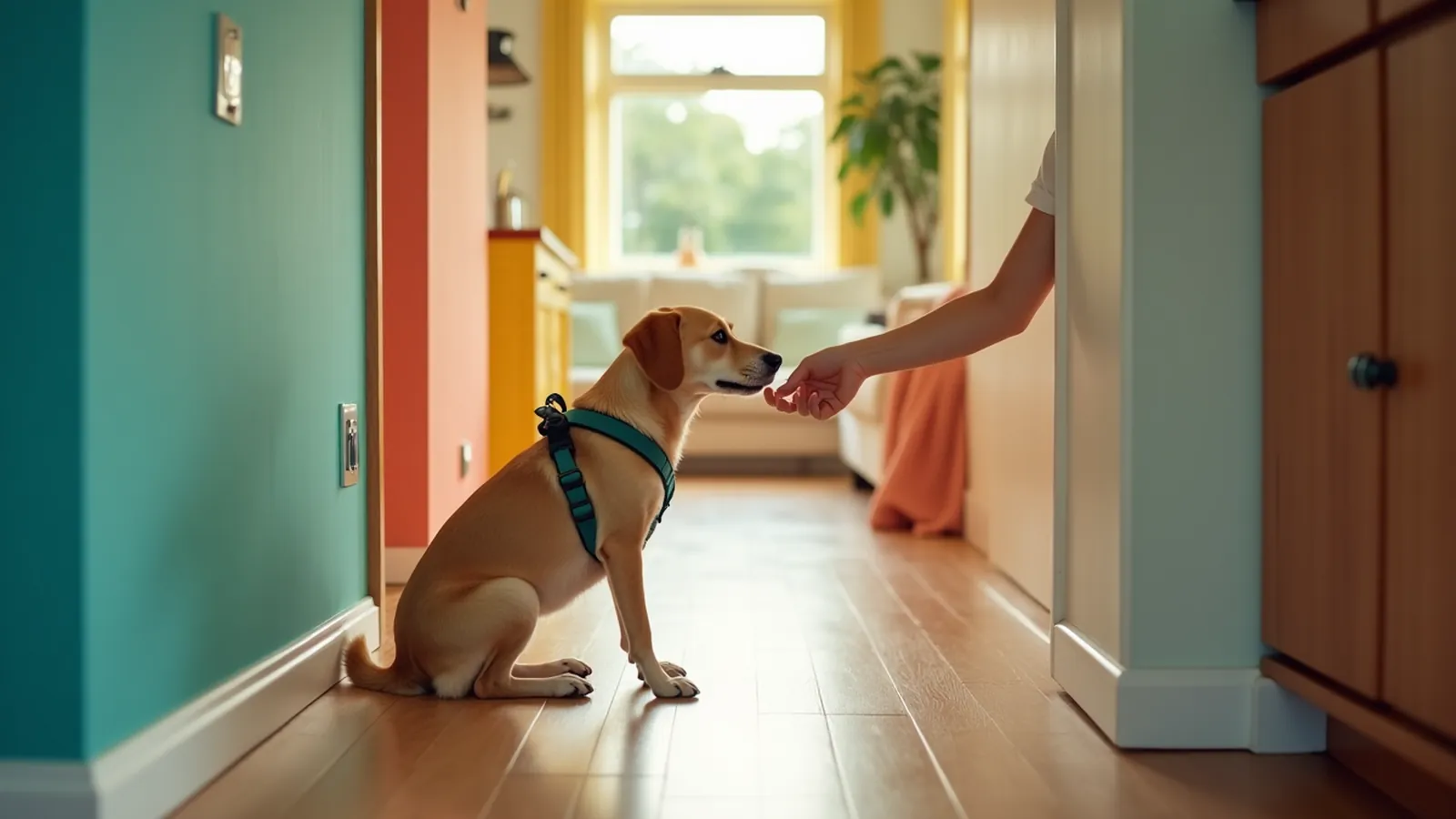
You cannot proof a cue in a room where two dogs are competing for the same piece of chicken, and trying is how a session turns into a wrestling match. Train one dog at a time and gate the other where he can hear but not join in. Note where each dog finished so you know where to start next time.
The puppy and the rescue will move at different speeds, and that is expected rather than a problem. Best Friends, writing for people who adopted dogs from puppy mills, asks owners to "Be patient" and is honest about the range: "House-training might take a week, it might take a month, or it might take a year." The same honesty applies to proofing a cue with a fearful dog. The 3-3-3 rule for rescue dogs explains why a dog who is still settling in may need everything kept smaller for longer.
That page is also blunt about corrections, within its own scope: "Punishment is never a good idea when house-training a dog, but it can be even more harmful for the fragile and sensitive emotional makeup of rescued puppy mill dogs." For a rescue, that is a good reason never to correct a missed cue. Back up a step and pay more instead.
What gear and paid programs will not do for you
A harness changes how a pull feels; it does not teach your dog what to do instead. Gear and training are separate jobs, and the no-pull harness guide covers what to look for and how to check fit.
If the videos and tips you have tried so far have not changed anything, the next question is not more tips but sequence: which cue to proof first, in which room, with which distraction, and what to do when the dog misses. Before you pay for a program, check that it names your exact situation, that it changes the environment as well as the cues, and that it is reward-based only. We have no affiliate relationship with The Online Dog Trainer today, and we earn nothing if you buy. If that changes, this sentence and the links will say so. If you would rather watch the skills demonstrated than described, the program this site points to is The Online Dog Trainer (opens in a new tab); what its own pages say, as listed on its site on October 27, 2026, is summarized in the Doggy Dan review, alongside free routes to the same skills.
Troubleshooting
- If your dog takes the treat and then ignores the cue
- The treat is not the problem; the step is. Go back to the last place he was right nearly every time and add a smaller version of the distraction.
- If he will not take food at all
- That is a dog over his threshold. Add distance, put a barrier between him and the trigger, or move to an easier version.
- If the squirrel appears mid-session
- Stop asking. Manage: turn and walk the other way, use the space you have, and pay the moment your dog can look back at you. A surprise is not a training rep.
- If the bell rings when you are not ready
- Let the visit happen, then run two easy reps near the closed door later the same day. One unplanned ring does not undo your work; it tells you where you are.
- If one dog sets the other off
- Separate them for training blocks and run one dog at a time. Do not pay the second dog for joining in, even with a well-meant treat to quiet him.
- If your rescue freezes or flattens
- Stop the session, lower your voice and your movements, and go back to a step he accepted easily. If he seemed distressed, give it a few days before you try again.
When to get professional help
Stop and call for help if
- Your dog growls, snaps, freezes or bites when a person comes to the door, or when you reach for his collar or harness.
- Barking or lunging at the door, on the leash or at other dogs comes with stiff body language, a hard stare or a snap.
- Your dog panics at sounds, injures himself, or cannot settle after a noise he used to ignore.
- There is a sudden change in an adult dog: new fear, new noise sensitivity, or new avoidance of a person or place.
- Two dogs in the house are in conflict over space, food or your attention.
Who to call. Start with your veterinarian: pain, illness and medication side effects can all show up as behavior changes. For behavior problems, look for a board-certified veterinary behaviorist (ACVB directory), a certified applied animal behaviorist, or a certified behavior consultant, for example through the IAABC or the CCPDT directories. Ask any trainer which methods they use; reward-based is what the American Veterinary Society of Animal Behavior recommends.
None of that means you have failed, and it does not mean your dogs are ruined. It means the problem has moved past manners into behavior and safety, and the next step is a veterinarian and a qualified behavior professional rather than another video.
Frequently asked questions
How long does it take to proof a cue against distractions?
There is no honest number, and anyone who gives you one is guessing. What you control is the size of each step and how often you practice. Judge progress by what your dog chooses: a dog who sits while the handle turns, or looks back at you when the bell plays, is further along than he was last week, whatever the calendar says.
Can I practice dog training with distractions without a real visitor?
Yes, and it is the better place to start. A phone recording lets you set the volume, the timing and the distance, which a real delivery never will. Begin quieter than you think you need, pay calm and a look back at you, and raise the volume over several short sessions. If your dog bolts, drop the volume again.
Where do I find dog doorbell sounds to practice with?
Any short bell or chime clip on your phone will do, or record your own bell for the closest match. Keep the volume low enough that your dog notices without leaving the floor, and keep sessions short. What matters is repetition you control, not the perfect sound file.
My dog knows 'sit' at home but not outside. Is that normal?
Very. Outdoors adds wind, traffic, other dogs, smells and space, so the cue has to be rebuilt there from an easier starting point. Start at the quietest spot you can find with the trigger far away, and treat the first outdoor successes as new learning rather than a test of what he already knew.
How do I run this with two dogs at different stages?
One dog at a time, with the other behind a gate. Give each dog a short session, pay the dog you are working with, and note where each one finished. The puppy may climb rungs faster than the rescue, and that is fine; each dog's progress is measured against his own last session, not against the other dog.
Sources
- Position Statement on Humane Dog Training, American Veterinary Society of Animal Behavior (accessed October 29, 2026).
- Owner-Reported Behavioural Problems in Dogs and Cats: A Survey of 2,757 Dogs and 1,171 Cats, PubMed Central (accessed October 29, 2026).
- What to Expect When Rescuing a Puppy Mill Dog, Best Friends Animal Society (accessed October 29, 2026).
- Mouthing, nipping and biting, Dogs Trust (accessed October 29, 2026).
One plan at a time, in an order that holds up
Jumping up, leash pulling, recall and distraction proofing, each with a step plan and reward-based methods only.