
Rescue Dog
Dog peeing when excited: a calm greeting plan for your rescue
The puddle at the door is not defiance and not a house-training failure. It is a greeting problem, and the fix starts with making hellos boring.
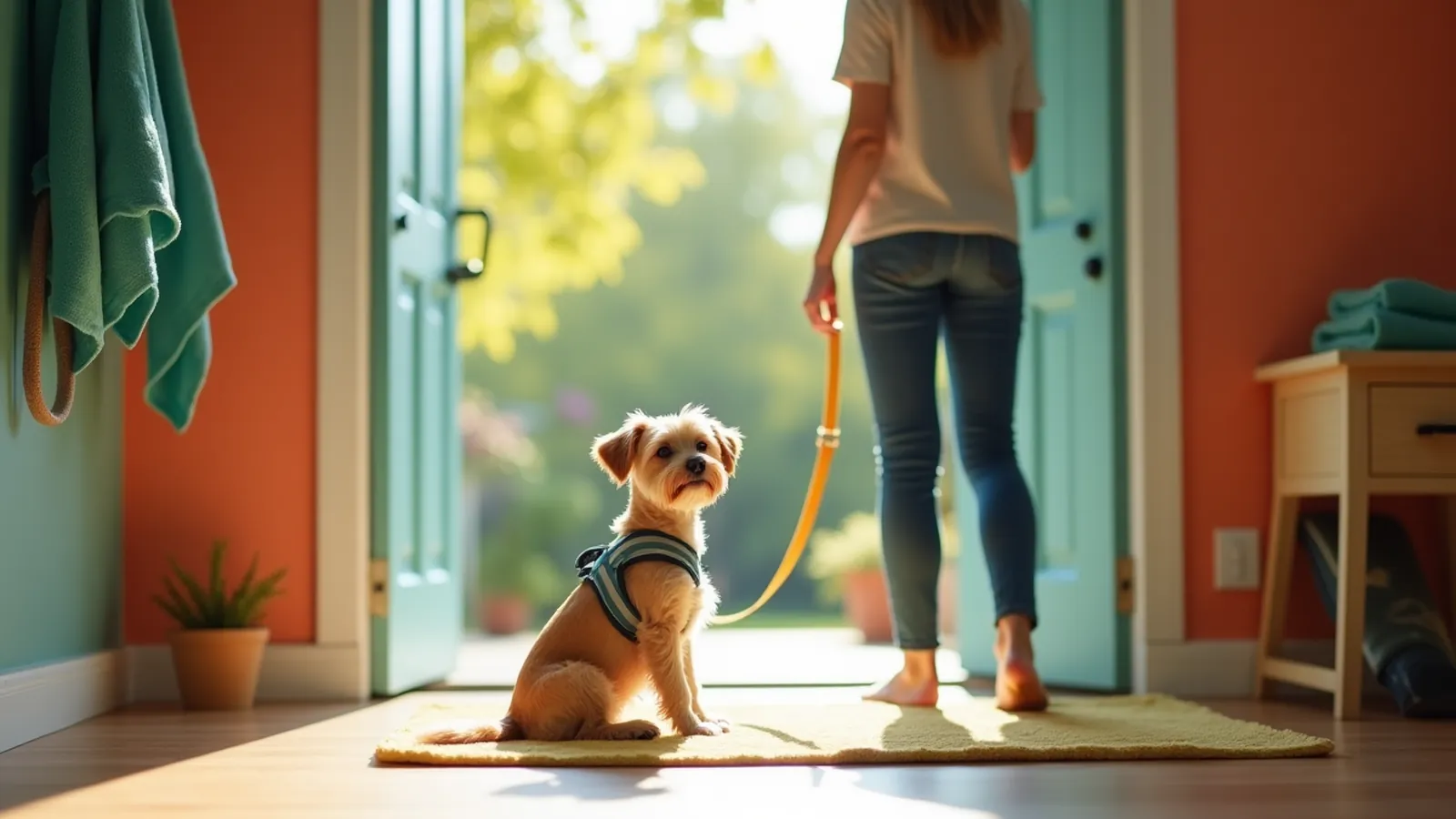
On this page (10 sections)
- What dog peeing when excited actually is
- The calm greeting plan, step by step
- How to stop a dog from peeing when excited: the greeting-distance ladder
- Cleaning up without making it worse
- Troubleshooting
- If tutorials and a class haven't fixed it
- When to get professional help
- Frequently asked questions
- Keep going
- Sources
The puddle shows up at the door, by the leash hook, and on the kitchen floor the second a hand reaches out to say hello. Your adult rescue dribbles urine whenever someone greets him or reaches for the leash, and the constant cleanup is testing everyone's patience, including yours. You are not doing anything wrong, and he is not being stubborn.
Dog peeing when excited is a greeting reflex: a small amount of urine leaks out when arousal spikes, or when a dog is a little unsure, and the bladder lets go before he can stop it. It is common in young dogs and in dogs still settling into a new home, though no one can tell you how often it will happen with your dog. This plan is not about teaching him to hold on by willpower. It is about emptying his bladder before the exciting part, making hellos dull, and building greetings up in small steps so he stops rehearsing the puddle. (Just adopted? The 3-3-3 rule for rescue dogs explains why the first weeks can look like this.)
Key takeaways
- Excitement urination is a greeting reflex, not a house-training failure and not defiance.
- Call your vet first about any new leaking, especially in an adult dog: only a vet can rule out a physical cause.
- Change the greeting, not the dog: low voice, sideways body, hands down, no reaching over the head.
- Empty the bladder first: a potty trip before guests, before the leash comes out, and after every nap or play burst.
- Punishment makes puddles more likely and cannot teach bladder control. Reward the dry hellos instead.
Do this today
- Take him out for a potty trip before the next exciting thing happens, and stay out until he goes.
- Put cloths and an enzymatic pet-mess cleaner by the door so cleanup is quick and quiet.
- Tell everyone in the house the new rule: hands down, no high voice, nobody touches him for the first minute of a greeting.
What dog peeing when excited actually is
Excitement urination is a brief loss of bladder control that arrives with a spike in arousal: someone walks in, the leash appears, a favorite person comes home, play starts. He is not emptying his bladder on purpose. He is usually very excited, slightly unsure, or both at once.
It is not the same as a house-training problem. A dog who is not yet house trained eliminates indoors at random moments, whether or not anyone is greeting him. A dog with excitement urination is usually clean the rest of the time and only leaks at greetings, leash-up moments and play. The routine below uses both ideas, because the two problems often overlap in a newly adopted dog. If house training itself is the puzzle, see how to house train an older dog.
It is also not something you can diagnose at home. Puddles can have medical causes, and only your vet can rule those out, so book a check-up, especially for an adult dog who has started leaking after being reliably clean.
Two things make these puddles more likely. The first is arousal itself: the wilder the greeting, the more likely the leak. The second is punishment. The AVSAB position statement on humane dog training sets out that reward-based methods are preferred and that aversive methods carry risks, including increased fear and avoidance, and fear is one of the states behind these puddles. Shouting, jerking the leash or pushing a nose into the puddle cannot teach bladder control.
Where your rescue is in his settling-in period matters too. A study of adopted shelter dogs asked owners to rate their dog's behavior at 7, 30, 90 and 180 days after adoption, a reminder that week one is not the finished picture.
The calm greeting plan, step by step
Work through these in order and keep each one small. If he leaks at any point, that step was too big: make it easier and repeat it.
Step 1: Empty the bladder before every greeting
Take him out on a leash and wait for a pee before the exciting thing happens: before guests arrive, before you pick up the leash, after every nap, after a play burst, before training, and last thing at night. Keeping him on a leash outside keeps the trip calm and lets you see whether he went. The timing logic is the same one behind a puppy potty training schedule, and it suits adult rescues too: an empty bladder cannot leave a puddle at the door.
Move on when: he reliably produces something on the pre-greeting trip, most of the time.
Step 2: Rewrite the arrival script
Most of the puddle is decided in the few seconds before the door opens. Write this down and give it to everyone in the house and every regular visitor.
- Before the door: potty trip, then settle him in the hallway or on a mat, on a leash, a little distance from the entrance.
- The entrance: no knocking if you can avoid it. Let your guest in quietly and ask them not to call out.
- The first minute: nobody touches the dog. No eye contact, no high-pitched hello, hands down at their sides.
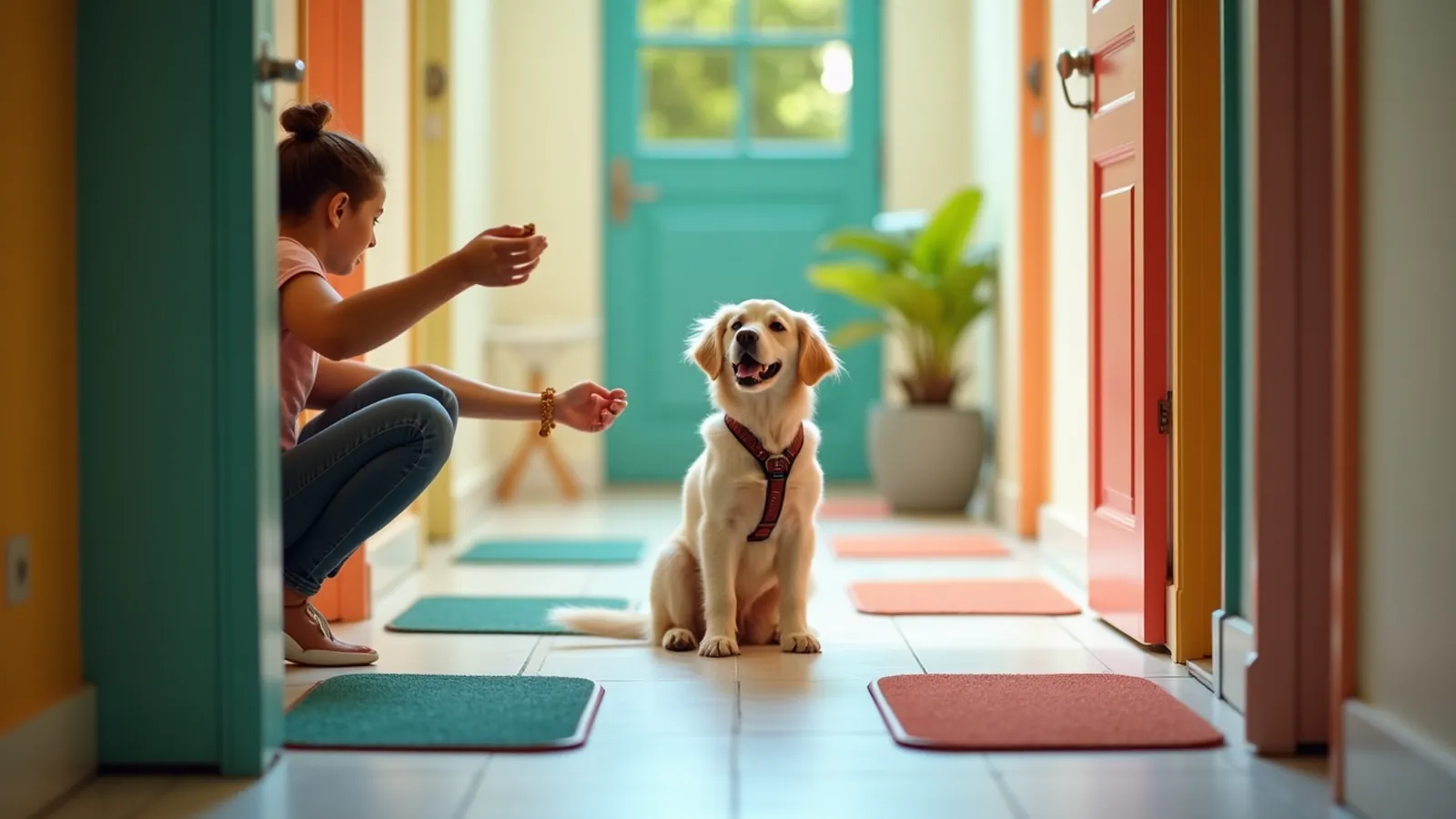
- The introduction: your guest sits down and turns slightly sideways, then tosses a treat past your dog's feet and waits.
- The touch: if he comes over, one slow stroke on the chest or shoulder, then hands away. Chest and shoulder are fine; the top of the head is a reach.
Move on when: he stays dry through a full visitor arrival with the script in place.
Step 3: Let him choose the approach
Sitting on the floor is not automatically better if you loom over him while you do it. Sit on a chair or the floor, turn your shoulder toward him and let him come the last few steps. If he hangs back, that is information, not rudeness: toss a treat a little to the side and wait. Reaching toward a dog who is already at the edge of excited is the fastest way to produce another puddle.
Move on when: he approaches on his own and stays dry.
Step 4: Make the leash boring
Many of the puddles by the leash hook come from the sudden spike of the clip. Practice on a quiet afternoon when nothing else is happening: pick up the leash, treat, put it down. Clip it on, treat, unclip. Repeat a few times a day until the sight of the leash stops being an event. If the leash goes on a harness, check the fit properly, because a harness that rubs or restricts is uncomfortable on every walk. Researchers have published a method for comparing how a dog moves walking free, in a harness and on a leash, a reminder that gear changes how a dog moves; that is about comfort and control, not greetings, so see how to check a no-pull harness fit for that side of things.
Move on when: he stands still and stays dry while the leash goes on.
Step 5: Give the greeting a job
A dog who is sniffing the floor and eating treats is not launching himself at chest height. Ask for one easy thing he already knows, such as a sit or a hand touch, then pay well. If he is too wound up to sit, skip the sit and scatter a handful of treats on the floor instead. Four paws on the floor is the whole goal, and eating off the floor buys you the seconds you need.
Move on when: he can offer the sit or take the scatter without leaking.
Step 6: Keep departures as dull as arrivals
Leaving and coming home are greetings too. Potty trip first, then a quiet exit with no long goodbye, and a quiet return: bag down, coat off, wait for four paws on the floor, then a calm hello. If the hallway is where the puddle always lands, take him straight out to the yard or the sidewalk instead and greet him out there.
Move on when: comings and goings stop being the most exciting part of his day.
How to stop a dog from peeing when excited: the greeting-distance ladder
Once the basics are in place, build the greeting up in stages. Distance is your dial: a visitor at the far side of the room is easier than a visitor in the hallway, and one calm adult is easier than three people at the door. Stay on each stage until he is dry and relaxed, then make it one notch harder.
| Stage | What you set up | What the person does | Move on when |
|---|---|---|---|
| 1. Rehearsal at home | A household member, a quiet room, treats in a bowl | Walks in, says nothing, tosses a treat on the floor, leaves | He stays dry with four paws down |
| 2. One visitor, across the room | One calm adult; dog on a leash at a distance | Sits sideways, no eye contact, no reaching, tosses treats | He stays dry and offers to approach |
| 3. Visitor a few steps closer | Same visitor, shorter distance, same leash | One chest stroke if the dog leans in, then hands away | He stays dry and walks away calmly after |
| 4. Full greeting script | Normal doorway, leash loose, potty trip done first | Follows the Step 2 script start to finish | Dry greetings on two visits in a row |
| 5. Real life, one variable at a time | Doorbell, then two people, then children last | Same low-key manner, more people | Each new element stays dry before you add the next |
Watch for
If he pees at a stage, that stage was too hard. Drop back one and repeat it rather than pushing through. A greeting that ends in a puddle is a rehearsal of the puddle, which is the one thing this plan is trying to avoid.
Cleaning up without making it worse
What you do in the thirty seconds after a puddle matters as much as the greeting itself.
- Say nothing. No sighing, no scolding, no holding him near the wet patch. He cannot connect a telling-off to a reflex he did not choose, and a tense cleanup only adds worry to the next hello.
- Clean for scent, not just for looks. Use an enzymatic cleaner made for pet messes rather than a general household cleaner, and wash bedding and mats that have been hit.
- Keep the kit by the door, so cleanup stays fast and unemotional, which is exactly the tone this plan needs.
- Manage the room. Washable mats in the greeting zone, bedroom doors closed during arrivals, greetings moved outside when the floor matters. Managing the environment is not cheating; it stops him rehearsing the habit while you teach the new one.
- Do not restrict his water. Taking water away to reduce puddles is a health question for your vet, never a training tactic.
Troubleshooting
- If he pees before you even touch the leash
- The leash has become a cue for the whole exciting routine. Leave it on the floor for a couple of days, then do the pick-up-and-treat game from Step 4 with no walk attached.
- If he only does it with strangers
- Have strangers ignore him completely. You handle the greeting, hand out the treats and keep him on a leash, and meet people outside rather than in the hallway.
- If he pees when you come home
- Change the order: potty trip first, calm entry second, and greet him outside if the hallway is the trigger.
- If he pees when you reach for his collar
- Teach the collar grab as its own trick: reach, treat, hands away, several times a day, until a hand near his neck predicts a snack rather than a trip to the vet.
- If he flattens, rolls over and won't come near
- That looks more like fear than plain excitement, and it needs a slower approach with more distance and no reaching at all. See the professional help section below.
- If the puddles only happen when he is alone
- That is a different problem. In a large survey of owners about dog behavior, urinating indoors in the owner's absence and when confined sat together in a cluster of elimination behaviors. Start with a separation plan rather than a greeting plan.
- If your dog is also jumping on people
- Same principle, different lesson: reward four paws on the floor and give the greeting a job. See how to stop a dog jumping on people.
If tutorials and a class haven't fixed it
It makes sense to be skeptical of another program that promises quick fixes. If you have already paid for a class, watched the tutorials and bought gear, and the puddles are still there, here is the honest version of what usually goes wrong.
Most advice focuses on the dog's behavior in the moment and skips the environment around it: who greets him, where the greeting happens, and what occurs in the seconds before the door opens. That part cannot be done for you by a video, and it cannot be bought.
Gear deserves a clear word too. A front-clip harness changes how pulling feels on your arm; it does not teach a calm hello, and no harness will stop excitement urination. Buy one for comfort and control if you need it, not for this problem.
On paid programs: this site has no testimonials or case studies to show you, because inventing them would be dishonest. This site does not claim to have used any paid program. We have no affiliate relationship with The Online Dog Trainer today, and we earn nothing if you buy. If that changes, this sentence and the links will say so. If you want to weigh one up, read what its own pages list, dated, in our Doggy Dan review, and compare it with the free step plans here. If a program promises a fixed result in a fixed number of days, keep your money.
When to get professional help
Stop and call for help if
- Leaking has started suddenly in an adult dog who was previously clean, or comes with straining, blood, or much more drinking and urinating than usual. That is a vet visit, not a training problem.
- He flattens, freezes, rolls over, tucks his tail or tries to leave whenever a person reaches toward him.
- He growls, snaps or bites when approached, touched or handled.
- He panics or hurts himself when left alone, or the puddles only happen when he is by himself.
- His worry around people is getting worse rather than slowly better, or it is spilling into walks, vet visits and daily handling.
Who to call. Start with your veterinarian: pain, illness and medication side effects can all show up as behavior changes. For behavior problems, look for a board-certified veterinary behaviorist (ACVB directory), a certified applied animal behaviorist, or a certified behavior consultant, for example through the IAABC or the CCPDT directories. Ask any trainer which methods they use; reward-based is what the American Veterinary Society of Animal Behavior recommends.
This page is written from published guidance and general training practice. It is not veterinary or behaviorist advice for your individual dog, and no article can be.
Frequently asked questions
Why does my dog pee when excited?
Because arousal and bladder control compete, and arousal wins for a moment. A spike of excitement, or a flicker of uncertainty at a greeting, can make a small amount of urine leak before the dog can stop it. It is a reflex, not a choice, and it is common in young dogs and in dogs still settling into a new home.
How do I stop dog excited peeing?
Change the greeting rather than the dog: a potty trip before anyone arrives, quiet arrivals with hands down and no eye contact, letting him approach you instead of reaching for him, and a small job such as a sit or a treat scatter. Then build up the ladder above, one stage at a time, until a normal doorway hello stays dry.
Is excited dog peeing the same as submissive urination?
They are close cousins and often lumped together. Excitement urination tends to come with a wiggly, bouncy, hard-to-contain dog; submissive urination comes with a lower, more worried posture, often when a person leans over. Both get worse with scolding and better with calmer, lower-key greetings.
Will my rescue dog grow out of it?
Many dogs do less of it as they mature and as greetings become calmer and more predictable, but nobody can promise a timeline for your dog, and this page will not pretend otherwise. The plan helps either way: it lowers the arousal at the door and teaches him what to do instead.
Will a harness or a crate stop it?
Neither is designed to. A crate helps with house training and safe management, and a well-fitted harness helps you keep control on a walk, but excitement urination is driven by arousal at greetings. Use gear for comfort and safety, and use the greeting plan for the puddles.
Sources
- Position Statement on Humane Dog Training, American Veterinary Society of Animal Behavior, 2021 (accessed October 29, 2026).
- Shelter Dog Behavior After Adoption: Using the C-BARQ to Track Dog Behavior Changes Through the First Six Months After Adoption, Bohland et al., PLOS ONE, 2023 (accessed October 29, 2026).
- An Owner-Reported Survey on Dog Problem Behaviors: A Principal Component Analysis, PLOS ONE, 2020 (accessed October 29, 2026).
- A Gait Analysis Method for Comparing a Dog's Free Movement, Movement in a Harness and Leashed Walking, PLOS ONE, 2022 (accessed October 29, 2026).
Just adopted? Start here
Settling a rescue dog in the order that matters: the first days, house training, calm greetings and alone time.