
Adult Dog Manners
How to stop dog counter surfing without scaring the dog you are still earning trust with
Every unattended sandwich and thawing chicken breast is at risk the second you turn around. This plan makes the counter worthless, makes the floor worth checking, and gives you a calm script for the moment you catch him up there.
On this page (12 sections)
- Why a counter surfing dog keeps checking the counter
- Why shouting, rattle cans and "off" do not stop a dog counter surfing
- How to stop dog counter surfing: the step-by-step plan
- What to do in the moment you catch your dog on the counter
- Kitchen set-ups that stop the practice
- What counter surfing dog training actually looks like
- What this plan will not fix
- Troubleshooting a counter surfing dog
- When to get professional help
- Frequently asked questions
- Keep going
- Sources
You cannot leave a sandwich on the counter for the length of one phone call, and whatever you put out to thaw is at risk the second you turn around. When you are running a puppy on one side of the kitchen and a rescue on the other — a rescue who may have been shouted at in an earlier home for exactly this — a raid can feel like proof you are getting this wrong. You are not. A dog who checks the counter is doing what dogs do when food appears at nose height: he is being paid by the food itself, and the pay is why the habit holds on.
Learning how to stop dog counter surfing comes down to two halves that run together. The counter stops paying: nothing worth stealing is left out, and your dog has no access while you are not watching. The floor starts paying more: food arrives between four paws often enough that checking the tiles becomes the habit instead of checking the countertop. Add a calm script for the moment you walk in and find two front paws up there, and you have the whole plan. It is reward-based throughout — no shouting, no rattle cans, no aversive gear.
Key takeaways
- A counter surfing dog is paid by the food itself, so clearing the counters and blocking access does most of the early work.
- Move the bread, fruit bowl, butter dish and anything thawing; secure the trash can; push chairs and step stools in.
- Gate, close or pen off the kitchen whenever you cannot watch. Every unattended sandwich is a rehearsal.
- Make the floor pay: scatter part of each meal, use food toys, and reward four paws down whenever you notice them.
- Teach a mat where good things arrive while you cook, so your dog has a job that is not the counter.
- Growling, snapping or freezing over food is a safety issue: see your vet first, then a qualified behavior professional.
If you are running a puppy and a rescue at the same time
Counter surfing is rarely the thing keeping you awake. Pick one plan at a time and let the others wait a week. Puppy biting and leash pulling each have their own step-by-step page, and the New Puppy start-here page puts biting, crate and potty training in a workable order. For the rescue, the 3-3-3 rule for rescue dogs explains why a dog who is still settling in may need the kitchen gate up for longer than a puppy would.
Why a counter surfing dog keeps checking the counter
A kitchen counter is almost a training machine for the wrong behavior. Food sits at nose height, unattended, for minutes at a time, and the payoff is instant. A dog who has scored once will check again, and each success makes the next check more likely. None of that requires a guilty conscience or a theory about who is in charge. It is food and access.
Three things make it worse. Reach: a tall dog can smell the counter without leaving the floor, a smaller dog learns to jump, and a puppy who cannot reach today will reach in a few months. Timing and hunger: counters get raided most when meals are irregular and a dog has nothing to do while you cook. Practice: every unattended sandwich is a training session for the wrong behavior.
If the raiding only happens when you are out, treat it as two problems: the kitchen set-up here, plus alone-time training, which the separation training guide covers. In one survey of owners, destructiveness while the owner was absent was reported for about 45% of dogs, so a dog who gets into things when left alone is far from unusual.
Why shouting, rattle cans and "off" do not stop a dog counter surfing
Most counter surfing happens when nobody is watching. By the time you react, your dog is back on the floor or finishing the evidence. What he learns is not "stay off the counter" but "don't get caught" — or "grab it and run". Startling methods aimed at the counter tend to create new problems rather than settle the old one: a dog who is frightened near food can become tense around people when food is present, or start eating faster and guarding.
Good Dog Basics follows the AVSAB Position Statement on Humane Dog Training, so this plan uses rewards and management only. It does not use or recommend shock collars, prong or choke chains, rattle cans, spray bottles, shouting or leash jerks — not in the kitchen, not anywhere else. Reward-based training is not just the gentler choice: in a 2020 trial published in Frontiers in Veterinary Science, the reward-based group gave correct responses to a single cue more often and needed fewer repeated cues than the other groups, including a group trained with remote electronic collars. You do not need to add anything unpleasant to teach a dog where the food comes from.
How to stop dog counter surfing: the step-by-step plan
The plan has two halves that run together: access, so the counter stops paying, and an alternative, so the floor starts paying. With only the first you get a dog who waits for the one time you forget the gate. With only the second, he will still take a free sandwich when one is offered.
Audit the kitchen and clear the counters
Walk your kitchen at dog height and move everything edible or interesting: bread, fruit bowls, butter dishes, snack packets, and anything defrosting. Thaw meat in the fridge, not on the counter. Put the trash can inside a cabinet or use one with a locking lid, and push chairs and step stools in.
Then sweep before you cook, before bed, and before you leave. The biggest change you can make today is that there is nothing worth stealing.
Put a barrier between your dog and the counter
Choose one: a pet gate across the kitchen doorway, a closed door, or an exercise pen fencing off the work area. Use it whenever you cannot watch — while you cook, while you eat, and whenever you leave.
Make the barrier a good place to be. Feed meals and give long-lasting chews on the near side of the gate, and drop a treat over when your dog settles. If whining starts, wait for a pause, reward that, and make your next absence a little shorter.
Move on when: your dog settles by the gate with a chew instead of pacing at it.
Make the floor the best-paying place in the kitchen
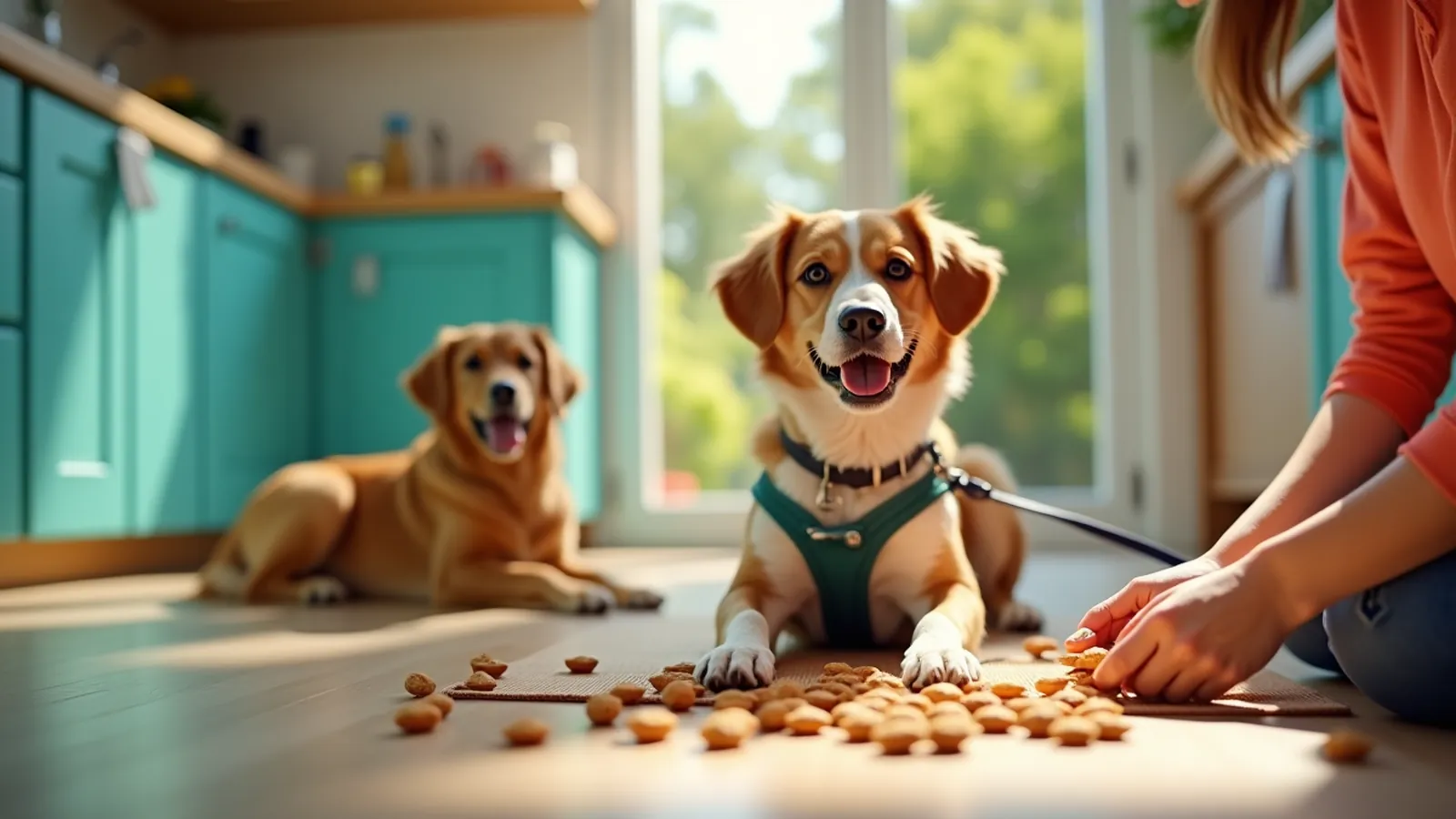
Every meal is a chance to pay the floor. Scatter part of the daily ration across the tiles, or stuff it into a food toy or snuffle mat while you cook. Whenever you see four paws on the floor near the counter, drop a treat between them.
The rule to remember: the counter pays nothing, the floor pays often. A dog hunting kibble on the floor is not jumping on the counter.
Move on when: your dog checks the floor when you walk into the kitchen, not the counter.
Teach a mat or "place" cue
Pick a bed or mat out of the cooking path. Lure your dog onto it, reward, then reward again for lying down. Build the time in small steps, add a cue word, and use it every time you cook. A dog with a job — lying on the mat — has much less reason to invent one.
Move on when: your dog heads to the mat when you start cooking, before you ask.
Test it with a decoy, in tiny steps
Put an empty plate or a cool, empty pan on the counter and stand nearby. Reward every choice to stay on the mat or the floor. If your dog moves toward the counter, block quietly — step between him and the counter, or walk him back to the mat — then reward. Then make it harder: stand further away, turn your back for a second, add a second decoy, or try it on a busy evening. Change one thing at a time and go back a step whenever the surfing returns.
"Leave it" is worth teaching for the food you drop, and a recall lets you call your dog out of the kitchen from another room. The full recall plan is in how to teach a dog recall.
Keep going: keep paying the floor often while the habit fades, then keep it occasional. You may keep the gate up for the times you are out even after the mat routine is reliable, and that is a reasonable long-term choice, not a failure.
What to do in the moment you catch your dog on the counter
The moment matters less than the ten minutes after it, but the wrong reaction there can set you back.
- Do not shout and do not lunge. A sudden yell or a fast move toward the counter turns it into a chase, and a startled dog can pull hot pans or broken glass onto the floor.
- Get him off with a cue, not a grab. Cheerfully call him to the mat, or toss a treat on the floor behind you. Four paws on the floor is the behavior that gets paid.
- If he already has food, trade. Toss something better a few feet away and pick the item up while he takes it. Do not pull a stolen chicken breast out of a dog's mouth. If he stiffens over it, growls or snaps, stop: the ASPCA says not to punish or intimidate a food-guarding dog, and that guarding is a safety issue rather than a manners one.
- Reward him the moment he is down. This is the hidden gift in catching him: you get to pay for the right behavior at exactly the right moment.
- Then fix the environment. Ask two questions — what did he get, and what will be different before the next meal? The counter is the thing to correct, not the dog.
What not to do: chase him around the kitchen, grab his collar, drag him down by the leash or harness, or bang a pan. None of those teach him where to put his paws, and all of them spend trust you may be building back from a hard start.
Kitchen set-ups that stop the practice
Start with the strongest set-up you have and step down as the mat routine gets reliable. The goal is simple: a jump on the counter cannot succeed.
| Set-up | Use it when | Why it works |
|---|---|---|
| Closed kitchen door | You leave, at night, during meals | No audience, no access, no jump |
| Pet gate across the doorway | While you cook and eat | Your dog can see and hear you but cannot reach the counter |
| Exercise pen | Puppies, jumpers and climbers | Fences off the cooking zone so two dogs can be separated |
| Trash can in a cabinet or under a locking lid | Every day | The trash is often a higher-value target than the counter |
| Food toy or snuffle mat | While you cook | Gives the floor something to do at the tempting moment |
This site does not pick brands or claim to have tested any gate. If you are choosing one, compare the height against your dog's jump, the bar spacing against a puppy's head, and how the latch opens when your hands are full: search pet gates on Amazon (Amazon, affiliate link) opens in a new tab.
What counter surfing dog training actually looks like
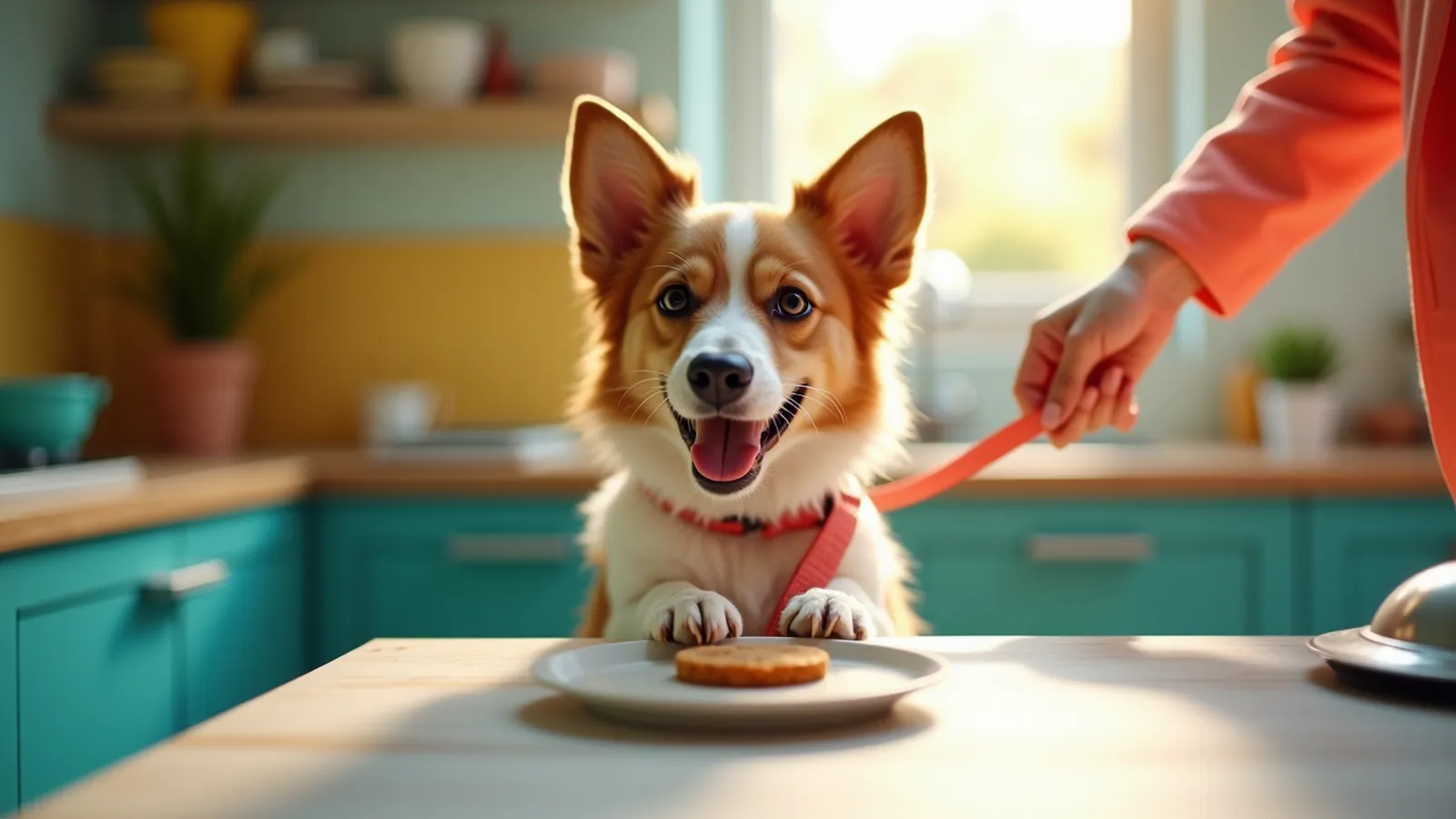
A household has an adolescent rescue who jumps up at the counter and a young puppy who cannot reach it yet. The gate goes across the kitchen doorway. The puppy gets a stuffed food toy on one side; the rescue gets half his dinner scattered across the tiles on the other, so neither dog is competing for the same floor. The owner chops vegetables and drops a piece of carrot each time the rescue looks at her with four paws down. Then she puts an empty plate on the counter and steps back. The rescue leans toward the gate, glances at the plate, and drops to the floor; the carrot arrives. A few minutes later he takes himself to his mat and lies down. The owner stops there, and the puppy never rehearses the jump at all.
What this plan will not fix
This page is a management and reward plan for a dog who steals food from surfaces. It is not a treatment plan for everything else in your house.
- It will not fix food guarding. If your dog growls, freezes or snaps when you reach toward food, a bowl or a stolen item, stop and read the next section.
- It will not fix panic when left alone. A frantic, destructive or soiling dog is a separate plan and possibly a separate professional.
- It is not veterinary advice. A sudden change in appetite, weight or behavior is a vet question before it is a training question.
- It comes with no timeline. There is no reliable number of days for this or any behavior, and anyone who gives you one is guessing. Watch your dog's choices instead.
This site is not a veterinary practice or a behavior consultancy. The pages are written with AI-assisted drafting and checked against the sources at the bottom; how we write explains the process and its limits.
Before you pay for a program
It is reasonable to want evidence before spending on a course, a front-clip harness or a bigger crate. No program, free or paid, can promise a result; what you can check is whether it names your problem, whether it changes the environment as well as the cues, and whether it uses reward-based methods only. We have no affiliate relationship with The Online Dog Trainer today, and we earn nothing if you buy. If that changes, this sentence and the links will say so.
If you want to see a mat settle, a leave-it and a recall demonstrated rather than described, the program this site points to is The Online Dog Trainer (opens in a new tab); its own sales pages, as listed on its site on October 27, 2026, are summarized in the Doggy Dan review, along with which free routes reach the same skills. The plan above and the Adult Dog Manners guide are enough to start tonight, and this page is not going anywhere.
Troubleshooting a counter surfing dog
- If it only happens when you are out of the house
- Keep the barrier up every single time you leave and work on alone time separately, with the separation training guide.
- If the whining at the gate is hard to listen to
- Wait for a pause in the noise, reward it, and shorten your next absence rather than opening the gate mid-whine. Feed and chew at the gate so it becomes a good place to be.
- If your dog is a jumper or a climber
- Choose a taller gate, use a closed door, or block the work zone with an exercise pen. Do not rely on a low barrier and hope.
- If you catch him and the food is already gone
- Let it go; there is nothing left to teach in that moment. Reset the kitchen and reward the next good choice. If he swallowed something risky — cooked bones, chocolate, medication, onion or garlic — contact your vet right away.
- If one dog raids and the other guards the floor
- Feed and scatter in separate spaces behind separate barriers. A shared scatter bowl creates competition you did not intend, and guarding is a safety question.
When to get professional help
Stop and call for help if
- Your dog growls, snaps, freezes or bites when you reach toward food, a stolen item, a bowl or the counter. The ASPCA describes food guarding as something to treat gradually with desensitization and counterconditioning, managed carefully in the meantime, and advises seeking a qualified behavior professional rather than handling it alone.
- Your dog seems hungry all the time, is losing weight, or his appetite or behavior has changed suddenly. Start with your veterinarian.
- Your dog is eating non-food items — plastic, cloth, rocks, paper — or you are worried about a blockage.
- Your dog panics, hurts himself, or is frantic when separated from you behind the gate.
- Two dogs in the house are in conflict over food, space or you.
Who to call. Start with your veterinarian: pain, illness and medication side effects can all show up as behavior changes. For behavior problems, look for a board-certified veterinary behaviorist (ACVB directory), a certified applied animal behaviorist, or a certified behavior consultant, for example through the IAABC or the CCPDT directories. Ask any trainer which methods they use; reward-based is what the American Veterinary Society of Animal Behavior recommends.
None of that means you have failed, and none of it means your dog is ruined. It means this problem has moved past manners into behavior and safety, and the next step is a vet and a qualified behavior professional rather than another video. If the dog is newly adopted, the Rescue Dog start-here page covers what the first weeks usually look like.
Frequently asked questions
How do I stop dog counter surfing quickly?
Start with access, because it works today: clear the counters, secure the trash can, and gate or close the kitchen whenever you cannot watch. Then make the floor pay with scattered food, and teach a mat for cooking time. There is no honest number of days for the habit to fade; watch whether your dog checks the floor instead of the counter, and go back a step if surfing returns.
Is a counter surfing dog trying to be in charge?
No. It is food and access. Food appeared at nose height, your dog reached it, and the payoff was instant, so he checks again. That tells you exactly what to change: stop the pay at the counter and start paying the floor.
Should I set a trap to teach my dog a lesson?
Not with real food, and not with anything that startles him. A trap plus a scolding teaches a dog to grab food fast, and frightening a dog near food can make him tense or guard. Use empty or low-value decoys while you are watching and can reward the choice to stay on the mat.
Will counter surfing dog training work with two dogs in the house?
Yes, if you separate them for sessions and meals. Give each dog its own barrier, mat and scatter spot so neither competes for the same floor, and run short sessions with one dog at a time while the other waits in another room.
Sources
- Food Guarding, ASPCA (accessed October 29, 2026).
- Owner-Reported Behavioural Problems in Dogs, PubMed Central (accessed October 29, 2026).
- Efficacy of Dog Training With and Without Remote Electronic Collars vs. a Focus on Positive Reinforcement, Frontiers in Veterinary Science (accessed October 29, 2026).
- Position Statement on Humane Dog Training, American Veterinary Society of Animal Behavior (accessed October 29, 2026).
Everyday manners, in the order that works
Counter surfing, jumping up, leash pulling and coming when called, one clear plan at a time, with rewards and no aversive gear.