
Adult Dog Manners
Reactive dog training: a distance-and-reward plan for the dog who lunges
The stiffening, the bark, the lunge at a dog across the street: that walk is asking too much of your dog at once. This plan starts with distance, pays the moment he turns to you, and uses a planned U-turn when the gap closes.
On this page (12 sections)
- What is a reactive dog, and what the label leaves out
- The distance-and-reward loop: reactive dog training step by step
- Leash reactive dog: why the leash makes it bigger
- Will a harness fix it? What fit can and cannot do
- Dog lunging at other dogs, and dog lunging at people
- When there are two dogs at two different stages
- What to do when the lunge happens anyway
- Troubleshooting
- When to get professional help
- Frequently asked questions
- Keep going
- Sources
Your dog's head comes up, his body stiffens, the bark lands, and then he is lunging at the end of the leash at a dog three houses away. You turn around, take the long way home, and quietly cross that street off the map. It is embarrassing, it is exhausting, and it leaves you wondering whether every walk is teaching him to do it better.
Reactive dog training starts with one change: distance. Find the gap where your dog can still think and still eat, mark and pay the moment he turns back to you, and use a planned U-turn when the gap closes. That loop is the whole plan, and you can start it on your next walk.
Key takeaways
- Reactivity is an emotional response, not a challenge to your authority, so corrections make the feeling bigger rather than smaller.
- Your working distance is the one where your dog notices the trigger and can still take a treat and turn back to you.
- Mark and pay every turn toward you, so checking in becomes the habit instead of the lunge.
- Close the gap in small steps, changing one thing at a time, and never right after a reaction.
- A planned U-turn, started before the bark, keeps your dog from rehearsing the explosion.
- Lunging that comes with a bite, a snap, a freeze or a sudden change in behavior needs your veterinarian first, then a qualified behavior professional.
What is a reactive dog, and what the label leaves out
Reactivity describes the size and speed of a dog's response, not his character. A reactive dog reacts strongly to a trigger: another dog, a jogger, a person in a hat, a scooter, a dog behind a fence. The reaction might be barking, lunging, growling, freezing or trying to bolt, and it usually gets bigger as the trigger gets closer.
Leash reactive dog means the same thing with a leash attached. It describes behavior, not a diagnosis. Some reactive dogs are frightened and want the scary thing to move away; others are frustrated because the leash stops them reaching the other dog. The handling is much the same for both: add distance, pay calm, avoid rehearsal. Neither needs a correction, and a dog lunging on a leash is not trying to run the street.
Big reactions at barriers are common. In one survey, 762 dogs presented with separation-related problems; among them, barking when the dog could not reach an unfamiliar person or dog was reported in about 63%. Those dogs were not a walk-reactivity sample, so read it only as a reminder that a dog who boils over at a barrier is not uniquely broken.
What this page cannot do is tell you whether your dog reacts from fear, frustration, pain or something else. That is an assessment for your veterinarian and a qualified behavior professional. What you can do today is lower the pressure, keep your dog under his threshold, and pay the behavior you want to see.
The distance-and-reward loop: reactive dog training step by step
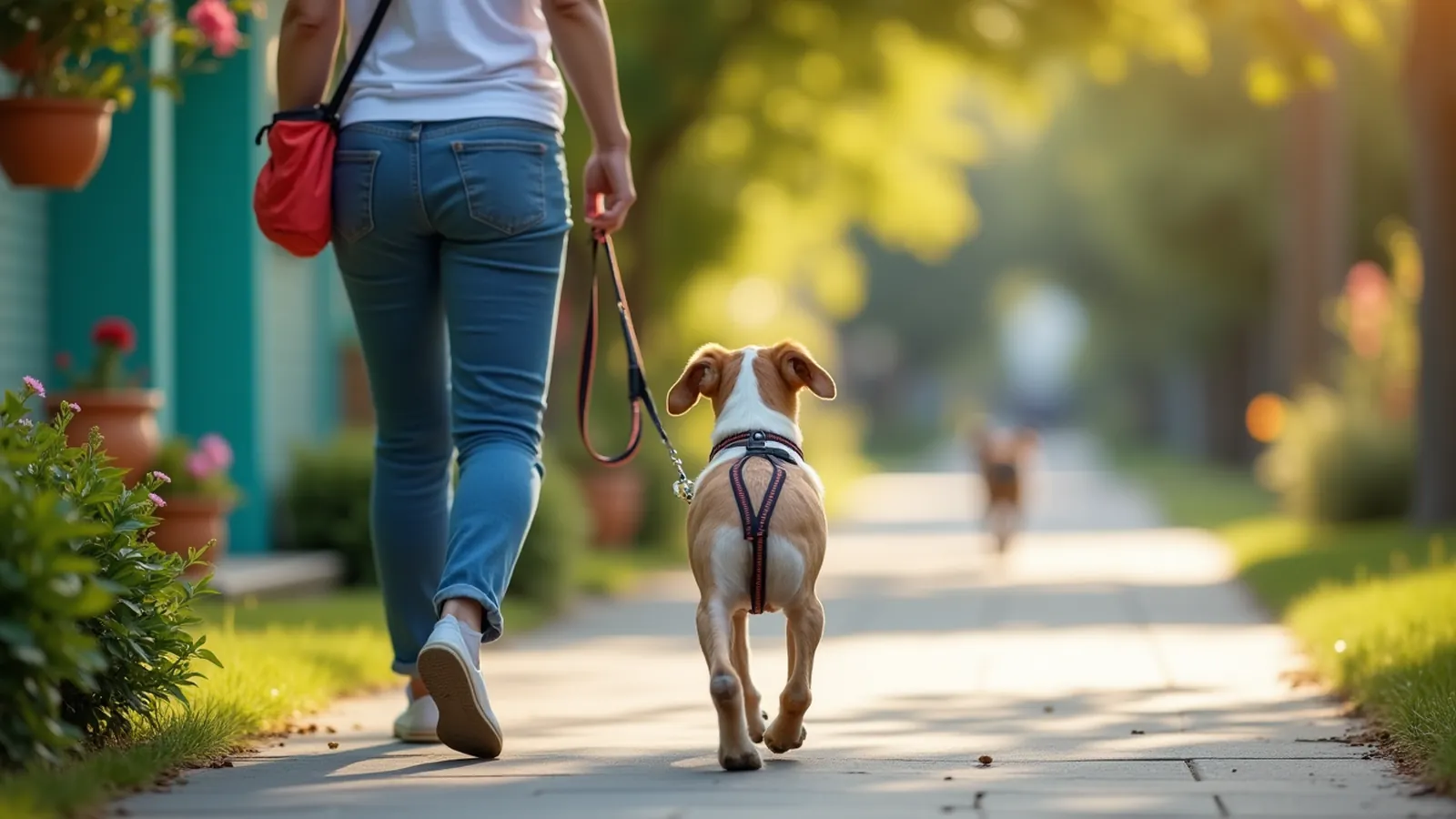
You need a harness that fits without rubbing, a fixed-length leash kept loose, and small food your dog actually wants. Start somewhere quiet, and accept that the first sessions may look like standing still on a sidewalk rather than walking.
Map your route before you train
Take two or three walks and note where triggers appear: which streets, which times, which yards have a dog behind the fence. Mark three places where you have room to step aside, a parked car to stand behind or a wide street to cross. That map is your training route for now.
Find the gap
When a trigger appears, read your dog's body: head lift, ears forward, hard stare, a pause in sniffing. Offer one small piece of food. If he takes it and turns back to you, you are inside the gap. If he takes it stiffly and keeps staring, you are at the edge, so add a few steps of distance. If he will not take food at all, you are over the edge: turn and walk away, and set up further out next time. Food refusal is information, not stubbornness.
Mark and pay the turn toward you
The instant your dog looks away from the trigger and toward you, mark it with a word ("yes" or "good") and deliver the food. That turn is the behavior you are growing. Pay it every time at first, even if it lasts half a second, and pay it when no trigger is in sight. Do not wait for the lunge to end and then reward; pay the choice to disengage.
Close the gap in small steps
Change one variable at a time: distance first, then whether the other dog is moving, then how many triggers are in view. A step closer is a step, not half a block. If your dog reacts, add distance back for the rest of that session and finish on something easy. Two or three good repetitions is a session; more than that and you are usually testing your luck.
Use the planned U-turn when the gap closes
Sometimes a dog appears from a driveway with no warning. Say your cue, turn your shoulders first, and walk the other way before the bark. Pay your dog once he is moving with you, keep the leash loose, and rehearse the turn on empty streets so it is smooth when you need it. That is management, not punishment: you are removing the rehearsal, not telling him off.
| What you see | Where you are | What to do |
|---|---|---|
| Notices the trigger, takes food softly, looks back at you | Inside the gap | Mark and pay the turn, do one or two more repetitions, then stop |
| Stares, takes food stiffly, will not turn away | At the edge | Add distance before the next repetition; quiet voice, loose leash |
| Barks, lunges, will not eat, cannot look away | Over the edge | Turn away, create distance, wait for recovery, end the training part of the walk |
What not to add
A reactive dog is already at the top of his emotional range, and pain or startle does not teach him what to do instead. Good Dog Basics follows the AVSAB Position Statement on Humane Dog Training, so this plan uses rewards and management only. It does not use or recommend shock collars, prong or pinch collars, choke chains, leash pops, alpha rolls, scruffing or "dominance" corrections, not for lunging and not for anything else.
Leash reactive dog: why the leash makes it bigger
The leash removes the two things a dog would normally do. He cannot move away politely, and he cannot approach and greet the way dogs do when they arc and sniff. Instead he meets the other dog head-on, at close range, on a tight line, often with both owners pulling as well. For a worried dog that is a trap; for an excited dog it is a frustration device.
What you can change is the setup. Cross the street early rather than at the last second, step into a driveway or behind a parked car, skip nose-to-nose greetings on leash, keep slack in the line, and use a well-fitted harness. None of that changes how your dog feels about other dogs; it lowers the pressure long enough for the distance-and-reward loop to do the real work. The guide to leash pulling covers the mechanics of a loose leash in more detail.
Will a harness fix it? What fit can and cannot do
A harness changes where leash pressure lands and gives you a second place to steer from. It does not change how your dog feels when he sees another dog, so on its own it will not stop the lunging. That is the honest answer to why the last no-pull harness did not solve the problem: it was doing a different job than the one you needed.
The research is limited, too. One study measured joint angles in four dogs walking on a treadmill in different harnesses; the authors reported that harnesses changed shoulder movement, and also wrote that the four dogs did not provide enough data for meaningful conclusions about the individual harnesses. So no study can tell you which harness to buy, and no page, including this one, should pretend otherwise.
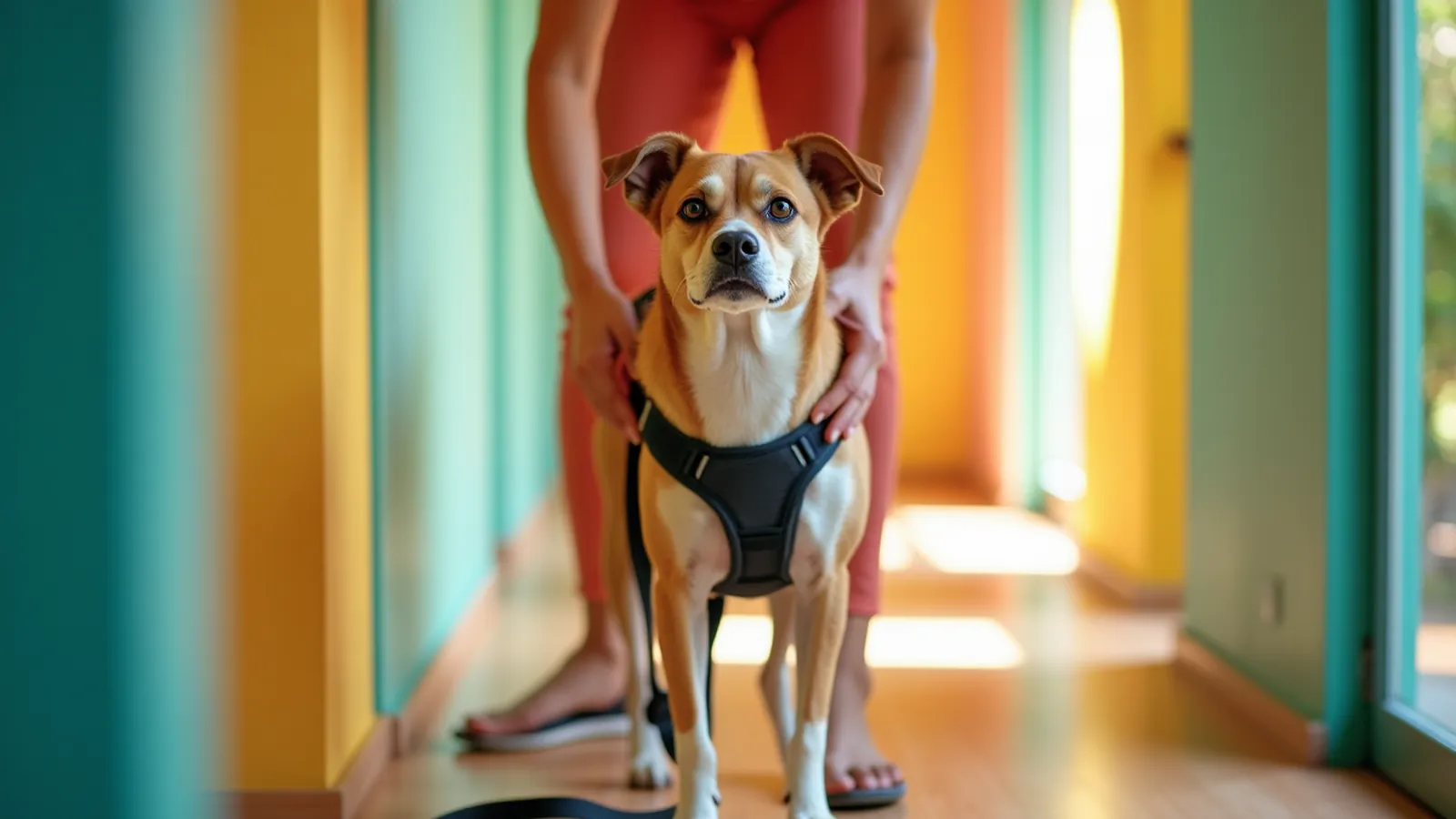
Check fit instead: straps clear of the eyes and throat, nothing digging in, nothing rubbing behind the elbows or across the shoulders, no chafing after a short walk in the yard. Watch your dog walk, trot and turn, and re-check as his coat and weight change. The no-pull harness guide explains what to look for, and the harness training plan covers a dog who is worried about wearing one at all.
Dog lunging at other dogs, and dog lunging at people
Dog lunging at other dogs usually happens on head-on approaches, which is exactly how most neighborhoods work: two owners walking toward each other on the same sidewalk. Change the geometry before you change anything else. Cross early, step into a driveway, or put a parked car between you. When someone approaches, say what you need out loud: "He's in training, we need space, please don't let your dog come over." Most people comply, and the ones who don't are worth walking away from.
Dog lunging at people often has its own triggers: joggers, cyclists, delivery workers, children, someone carrying an umbrella, a stranger who reaches out to pet him. A person walking straight at you is still a head-on approach, so the same loop applies: spot him early, create distance, feed as the person passes, mark and pay the turn back to you. Practice a short script that stops the reaching before it starts: "He's nervous, please don't pet him, we're training."
If your dog reacts to a person and cannot recover, or if the reaction includes a snap or a bite, stop the walk training and read the professional help section before you continue.
A dog reacts to every dog on his own street but can pass dogs calmly on a wide road two blocks away. His owner stops training on the home street for a month and works only on the wide road, at the distance where the dog can eat and turn away. Later, she moves one junction closer to home at a time.
When there are two dogs at two different stages
Train one dog at a time. While the reactive dog's loop is new, walk the dogs separately, even if that means two short walks instead of one long one. If you must walk both together, have one dog per person, keep the pair on the easier route, and never run a training repetition with two leashes in one hand. For the puppy, the same loop applies with more excitement and less fear: pay the check-in, keep greetings off the leash, and protect the habit while it is forming.
For the rescue, you do not need his history to run this plan, but assume a smaller margin. Best Friends Animal Society, writing about dogs rescued from puppy mills, advises patience: a first meeting in a neutral indoor space if possible, a barrier between the dogs at first, and face-to-face introductions one dog at a time with both dogs on leash. It also suggests feeding the dogs at least 10 feet apart, giving each dog his own bed and toys, supervising closely for the first week or two, and confining the dogs separately when you leave. None of that makes your dogs unfriendly; it removes the competition that starts arguments. The 3-3-3 rule for rescue dogs explains why a dog who is still settling in needs everything kept smaller for longer.
What to do when the lunge happens anyway
- Do not correct. This site does not use leash pops, shouting, a hand over the muzzle or a spray to stop a lunge. They add pain or startle to a dog who is already at his limit, and they can attach that unpleasantness to the other dog.
- Create distance immediately. Turn, walk, put a car between you. Do not stand still and wait for the other dog to pass if your dog is still barking.
- Wait for recovery. A shake-off, a slow blink, sniffing the ground, taking food again. Give him that time; it is part of the training, not a delay.
- Reset with a scatter. Toss a small handful of food into the grass and let him sniff it out. Sniffing lowers arousal and buys you both a moment.
- Write it down. Note the distance, the setup and what happened before the lunge. Next time start further out, and the reaction often does not happen at all.
Troubleshooting
- If your dog will not take food on walks at all
- Try a higher-value food first, then check whether he is over his threshold or simply full. Food refusal near a trigger is a distance problem; food refusal everywhere may be a motivation problem, which the guide to a dog who won't take treats walks through.
- If he reacts before you have time to turn
- You are meeting triggers too close. Change the route and the time of day for two weeks, and cross the street when you first see a dog, not when it is level with you.
- If he is fine at a distance but always explodes on the same corner
- Expectation is part of the trigger. Avoid that corner while you build the loop elsewhere, then approach it from a different direction at a greater distance.
- If he only reacts when both dogs are walked together
- Walk them separately while you train, one dog per person. Two dogs on one walk amplify each other, and neither one can learn in that setup.
- If the reaction seems worse in the first weeks
- Check your distance and your pace; more rehearsal, not less training, is the usual cause. Check with your vet if the change came on suddenly or comes with physical signs.
When to get professional help
Stop and call for help if
- Any reaction includes a bite that breaks skin, a snap, a muzzle-punch, or a freeze you cannot interrupt. Start with your veterinarian.
- The behavior started suddenly in an adult dog, or comes with limping, appetite or sleep changes, or pain when handled.
- Your dog panics rather than barks: screaming, trying to bolt into traffic, or injuring himself on the leash or a fence.
- He guards food, toys, a person or a resting spot from the other dog or from you.
- The two dogs in your house are in conflict, or one is being kept away from resources.
- You are avoiding all walks, or you have been bitten while moving your dog away from a trigger.
Who to call. Start with your veterinarian: pain, illness and medication side effects can all show up as behavior changes. For behavior problems, look for a board-certified veterinary behaviorist (ACVB directory), a certified applied animal behaviorist, or a certified behavior consultant, for example through the IAABC or the CCPDT directories. Ask any trainer which methods they use; reward-based is what the American Veterinary Society of Animal Behavior recommends.
None of that means you have failed, and none of it means your dogs are ruined. It means the problem has moved past street manners into safety and welfare, and the next step is your vet and a qualified behavior professional rather than another video. If money is the worry, ask your vet about local low-cost behavior options before you buy a course.
Before you pay for a program
If videos and a puppy class did not change the lunging, your skepticism is fair. Generic advice usually fails for a specific reason: it is not built around your dog's working distance, your routes, your rescue's margin or the fact that you also have a puppy to raise. What you can check before spending money: does the program name your exact problem, does it change the environment as well as the cues, is it reward-based only, and what are the refund terms. Any program that promises to end reactivity in a set number of days is telling you about its marketing, not about dogs. We have no affiliate relationship with The Online Dog Trainer today, and we earn nothing if you buy. If that changes, this sentence and the links will say so.
If you want to watch a distance exercise demonstrated rather than described, the program this site points to is The Online Dog Trainer (opens in a new tab); its own sales pages, as listed on its site on October 27, 2026, are summarized in the Doggy Dan review, along with free routes to the same skills.
Once the loop is reliable in quiet places, the next step is proofing it around distractions in a planned order, which the distractions guide sets out. This site is not a veterinary practice or a behavior consultancy. Pages are written with AI-assisted drafting and checked against the sources at the bottom; how we write explains the process and its limits. There is no reliable number of days for this or any behavior.
Frequently asked questions
How long does reactive dog training take?
There is no honest number of days. What you can measure is your dog's working distance: the gap at which he can still take food and turn back to you. When that distance starts shrinking on your usual route, the plan is working. Progress is usually uneven, and a bad day after a good week is normal rather than a sign of failure.
Why is my dog fine off leash but lunging on leash?
Off leash, your dog has choices: move away, arc around, or approach and greet. A leash removes all three and turns a normal meeting into a head-on approach at close range. That is why the plan is built on distance, slack in the line, early crossings and a planned U-turn, rather than on letting him sort it out on leash.
Is the plan different for a dog lunging at people?
Mostly it is the same loop: spot the person early, create distance, feed as they pass, mark and pay the turn back to you, and use a U-turn when you are surprised. Add a short script that stops strangers reaching for your dog. If a reaction to a person includes a snap or a bite, see your vet and a qualified behavior professional first.
Sources
- Position Statement on Humane Dog Training, American Veterinary Society of Animal Behavior (accessed October 29, 2026).
- What to Expect When Rescuing a Puppy Mill Dog, Best Friends Animal Society (accessed October 29, 2026).
- Evaluation of the effect of different harnesses on the kinematics of dogs, PubMed Central (accessed October 29, 2026).
- Owner-Reported Behavioural Problems in Dogs and Cats: A Survey of 2,757 Dogs and 1,171 Cats, PubMed Central (accessed October 29, 2026).
Lunging is the loudest piece of the leash picture
Pulling, lunging, jumping up and recall, one clear plan at a time, reward-based and with no aversive gear.